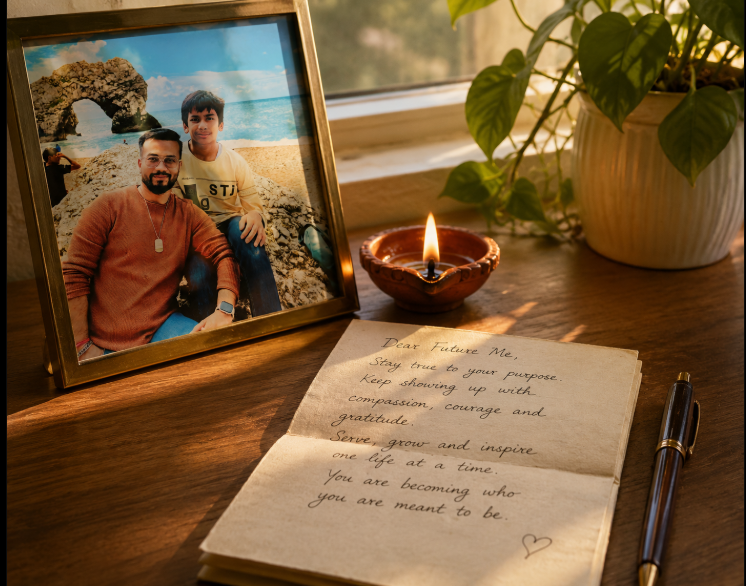
Last night I stood at your door longer than I meant to. You were asleep in that way only children sleep — completely, without negotiation, as if tomorrow were somebody else’s problem. And I thought of a question you asked me a few weeks ago, casually, the way you ask everything: “Bubui, do you like your work?”– (He lovingly address me as Bubuii 🙂 )
I gave you an answer that was true enough for a child. This letter is the answer that is true enough for a man. I am writing it now, while you are small, for you to read when you are perhaps twenty-five — old enough to have your own furnished rooms, your own offer letters, your own quiet three a.m. questions. Fold it away. It will keep.
One. Success can be a beautifully furnished room with no windows.
For many years I was, by every measure the world keeps, doing well. I flew between continents. I negotiated in boardrooms from Shanghai to Brussels. And somewhere in the middle of all that motion, I stopped being able to say why I was doing any of it.
Nobody warns you about this, so I will: the room gets more comfortable every year. The furniture improves. And the window you keep meaning to look for gets quietly papered over by the next appraisal, the next bonus, the next flight.
One day a salary and a title will ask you, very politely, to stop asking questions. Don’t. Being valued and being aligned are not the same thing, and the difference between them is the difference between a career and a life.
Two. It is never too late to become a student again.
This year — the year I am writing this — I did something that would have embarrassed the younger me. In my mid-forties, twenty years into being the expert in most rooms I entered, I signed up as a complete beginner. New certificates in subjects that didn’t exist when I studied. An eight-week course where I sit with strangers and learn, of all things, how to breathe.
Here is what I learned before I learned anything on the syllabus: expertise is a house, but curiosity is the door. A house without a door becomes, eventually, a tomb — well-built, admired, sealed.
You will one day be the most experienced person in a room and feel the smallness of it. When that happens, go and find a room where you are the least experienced person. It is uncomfortable in exactly the way growing is uncomfortable.
Three. Give something back to the ground you stand on.
I began my working life in laboratories, coaxing chemistry into foams and materials — making things. It took me two decades to hear the other half of that sentence: everything made is made from something, and the Earth keeps honest accounts even when we don’t.
So the second half of my working life is being given to the repair — to sourcing and materials that take less and return more. Not because it is fashionable, but because I finally understood something our tradition tried to teach me all along: work becomes worship the moment it serves something larger than the worker. The Gita calls it yajna. I call it, some mornings, simply being able to look at you without flinching.
Whatever you choose to do — and I genuinely do not mind what it is — ask of it one question: what does this give back? If the honest answer is “nothing,” you have found employment. Keep looking for work.
Four. Build the temple before the storm.
Every morning, before the house wakes, I sit. A lamp, a mantra, a silence you have occasionally wandered into, rubbing your eyes, wondering why Baba is talking to nobody. I am not talking to nobody. I am keeping an appointment.
I did not build this practice because life was hard. I built it while things were ordinary, so that when things stopped being ordinary — and they always, eventually, stop — there was somewhere to stand. The inner life is not a luxury for people with spare time. It is load-bearing. Nobody sees the foundation of a house, and the house stands because of it.
Find your own form of this. It needn’t look like mine — mantra, prayer, breath, a walk taken in silence, it hardly matters. What matters is that it is daily, and that it is yours, and that you build it before you need it.
Now let me imagine you, since a letter to the future is allowed one act of imagination.
You are twenty-five. You are in a city I have never seen, in a flat I will tease you about, holding an offer letter that pays extremely well for work that means almost nothing to you. Everyone around you is congratulating you. Something small and stubborn in your chest is not.
I know that room, Abhiroop. I furnished it for years.
I cannot tell you what to do in it — perhaps you take the offer, perhaps you don’t; there are seasons for both, and I took mine too. I ask only this: hear the small stubborn thing out. Give it ten quiet minutes before the noise of congratulations drowns it. It is not your enemy. It is the most honest advisor you will ever employ, and it works for free.
These are not instructions. You are not obliged to any of it — not my lessons, not my path, not even this letter. Burn it if you must. But if you burn it, light something with the flame.
And if you are not Abhiroop — if you have simply wandered this far down a stranger’s letter — then perhaps a line or two of it was addressed to you as well. Letters have a way of finding their true recipients. That, too, is something I’ve stopped being surprised by.
With more love than these paragraphs could carry, Yours lovingly- Bubui ( Dady)


Leave a comment