Category: Life & Career Reflections

  • Rising From the Ashes: Notes From an Unfinished Transformation

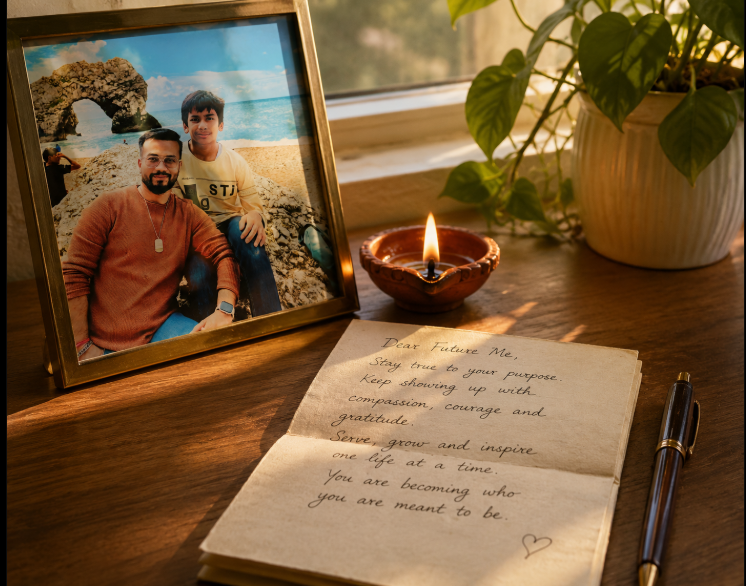
    There is a bird tattooed on my hand. A phoenix. People sometimes ask what it means, and I give them the short answer — rising from the ashes — because the long answer takes a lifetime, and I am still living it.

    This is not a story with an ending. Transformation, I’ve learned, is not a door you walk through once. It is more like a river that keeps arriving at the sea, remaking itself with every bend. What follows is simply a report from somewhere along the current.

    The Child Who Listened to the Old

    Some children run toward the playground. I was the one drifting toward the veranda where the elders sat. I have always felt a strange gravity toward the subtle — the unsaid thing beneath the said thing, the weather behind a person’s eyes. While others collected marbles, I was collecting impressions: a sense of self that arrived early, an emotional and cognitive empathy that let me feel the room before I understood it.

    My mother gave me my first compass. In her devotional life, I saw that the sacred was not a Sunday event but a daily posture. By fourteen or fifteen, I was reciting Sanskrit shlokas to Lord Shiva — not as homework, but as hunger. By nineteen or twenty, that hunger became surrender. I still remember tears arriving unbidden during remembrance of my deity, the kind of tears that don’t belong to sadness at all. They were the overflow of something too large to hold.

    The Garden Had Thorns

    But the same garden that grew that devotion was full of thorns.

    My high-school years were a siege of the body — recurrent fevers, month after month; a frame that was short, weak, feeble against the tall confidence of my peers. And there were disturbances of another order altogether — paranormal, psychic interferences that I understood later were not misfortune but intention. Harm was directed at me and at my family through the darker crafts, the kind that work in shadow. I say this plainly, though I will not name it further in public; some knowledge is best held, not paraded.

    For a long time I did not understand what was happening. But truth has a nature of its own: it never truly hides. It may arrive late — years late — but it always surfaces, the way a stone dropped in a well eventually shows its ripple. In time I came to know who the internal enemy was, the one who moved against us from close quarters. An inferiority complex took root in that soil, as such things do.

    And here is the part I hold with quiet awe: I did not have to lift a finger. I watched Mother Nature — call it karma, call it dharma, call it the long arithmetic of the cosmos — settle the account herself. Those who set the fire were, in time, consumed by their own. I witnessed it. Not with triumph, but with a chastened understanding that the universe keeps its own ledger, and no debt goes unrecorded.

    Even so — thorns are not the whole plant. Even then, good results at school earned me a quiet reputation, the respect of teachers, the trust of friends. Looking back, I see that the fever and the respect grew on the same stem. The wound and the gift were never separate. The oyster does not choose the grain of sand, but it decides what to build around it.

    The Turn After the Twenties

    Something shifted in my mid-twenties. The seed of bhakti planted so early finally cracked open and grew roots deep enough to hold weight — enough for a 360-degree turn.

    I often feel I am two people walking together: an inner guru and the sevak who follows him. Astrologically, this is written into my very chart — Jupiter and Saturn sit together in my first house, conjunct with my ascendant, the two great forces standing at the doorway of who I am. Jupiter, teacher of dharma; Saturn, relentless disciplinarian of karma. One points to the ideal; the other insists you earn it, slowly, in the currency of effort. Between the two, a life gets built.

    Why the Phoenix

    I chose the phoenix because I have, quite literally, felt the jaws of death close and then loosen. When you survive that, you stop negotiating with life for comfort and start asking it for meaning.

    Here is what I now hold as bedrock: life is uncertain, death is certain — and death is not a wall but a door. A threshold where prarabdha karma is carried forward, like a traveller changing trains but keeping the same luggage. If that is true, then how I live matters — not for reward, but because every action is a stitch in a garment I will wear again.

    So I choose consciousness over surface. Courage over comfort. And when I fall — I will fall, that is not in question — I choose to rise. Not because the ashes are pleasant, but because I have felt, more than once, what waits in the rising.

    The transformation continues. I would not want it any other way.


    And you? Somewhere in your own story there is a grain of sand you’ve been building around — a thorn that became a stem, a fall you’re still learning to rise from. I’d love to hear where you are on your own river. Leave a comment, share this with someone walking a similar path, or simply sit with the question tonight: what is your fire teaching you to become?

  • The Fourth Agreement of Life: Always Do Your Best

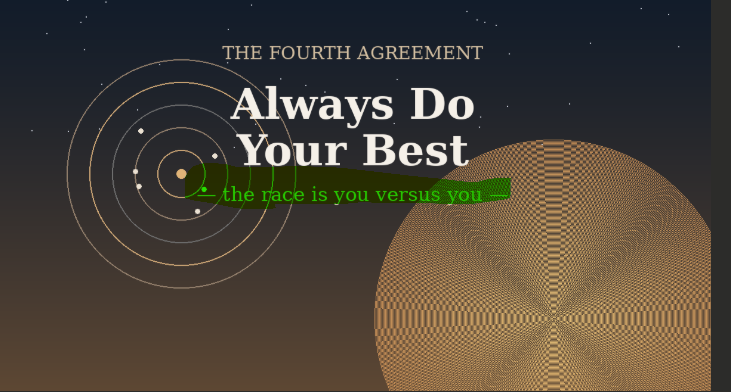
    There is one more agreement in Don Miguel Ruiz’s The Four Agreements, and it is the one that breathes life into the other three. Always do your best. Without it, the first three remain beautiful ideas — words on a page. With it, they become how you live.

    What I love about this agreement is its honesty. Ruiz is careful to say your best is never fixed. It changes from morning to night, from health to sickness, from a calm heart to a troubled one. Your best when you wake rested is not your best when you are exhausted, and that is perfectly fine. The agreement is not “always be excellent.” It is “always do your best — no more, no less.” Do more, and you burn out, going against yourself. Do less, and you hand yourself over to guilt and regret.

    For a long time, I missed this entirely. I was a day-dreamer. I lived in elaborate plans, rehearsing futures in my head, refining and re-refining the perfect approach before I had taken a single step. Planning felt like progress. It was not. It was a comfortable hiding place — analysis dressed up as preparation, paralysis dressed up as care.

    Aim, then shoot

    The shift came when I understood something simple: action brings clarity that thinking never can. You can analyse a problem for months and still not see what one honest attempt reveals in an afternoon.

    I now hold an analogy close in my own life. The old me wanted to aim, and calculate, and adjust, and perfect the shot — and somewhere in all that calculating, never actually shoot. The evolving me has learned to aim and then shoot. Then aim and shoot again. And again. The first shots will miss. They are supposed to. But each one teaches the next, and over time the aim sharpens through doing, not through deliberating. Precision is the reward of repetition, not of waiting for the perfect moment that never arrives.

    This is exactly what Ruiz means. He tells the story of the man who asks a Master how long he must meditate to transcend. Eight hours a day, the Master says, will take him longer than two — because he will only grow tired, miss the point, and forget to live. The lesson is not to grind yourself into the ground chasing perfection. It is to act with full presence, then let the doing teach you.

    The race is you versus you

    Here is the reframe that changed me most: the race was never against anyone else. It is you versus the person you were yesterday. Be a slightly better version today — that is the whole game. Not perfect. Better. And tomorrow, better again.

    When you measure yourself this way, the Judge loses its grip. Ruiz puts it plainly — when you have truly done your best, the Judge has nothing to convict you with. You have your answer: I did my best. No regret, no self-punishment. And freed from that fear, you stop needing the perfect conditions to begin.

    So I have made peace with imperfect action. I take small steps now — small, almost unglamorous steps — every single day toward the larger things I want. A page written. A conversation had. One shot taken. None of them feels like much in isolation. But Ruiz reminds us that everything we have ever mastered, we mastered through repetition. We learned to walk, to write, to speak our language, by doing it badly and continuing anyway. Practice makes the master. Action is what makes the difference.

    The plans I once mistook for progress have given way to something humbler and far more alive: showing up, doing my best for that day, and trusting the accumulation. Some days my best is brilliant. Some days it is barely enough. I no longer judge the difference. I just keep shooting.

    If you fall, Ruiz says, do not give the Judge the satisfaction. Stand up and begin again tomorrow. Today is the beginning of a new dream.


    So I’ll leave you with the question I keep asking myself:

    What is one small action you’ve been endlessly planning — and what would happen if you simply took the shot today, imperfect and all?

  • The Third Agreement: DO NOT Make Assumptions

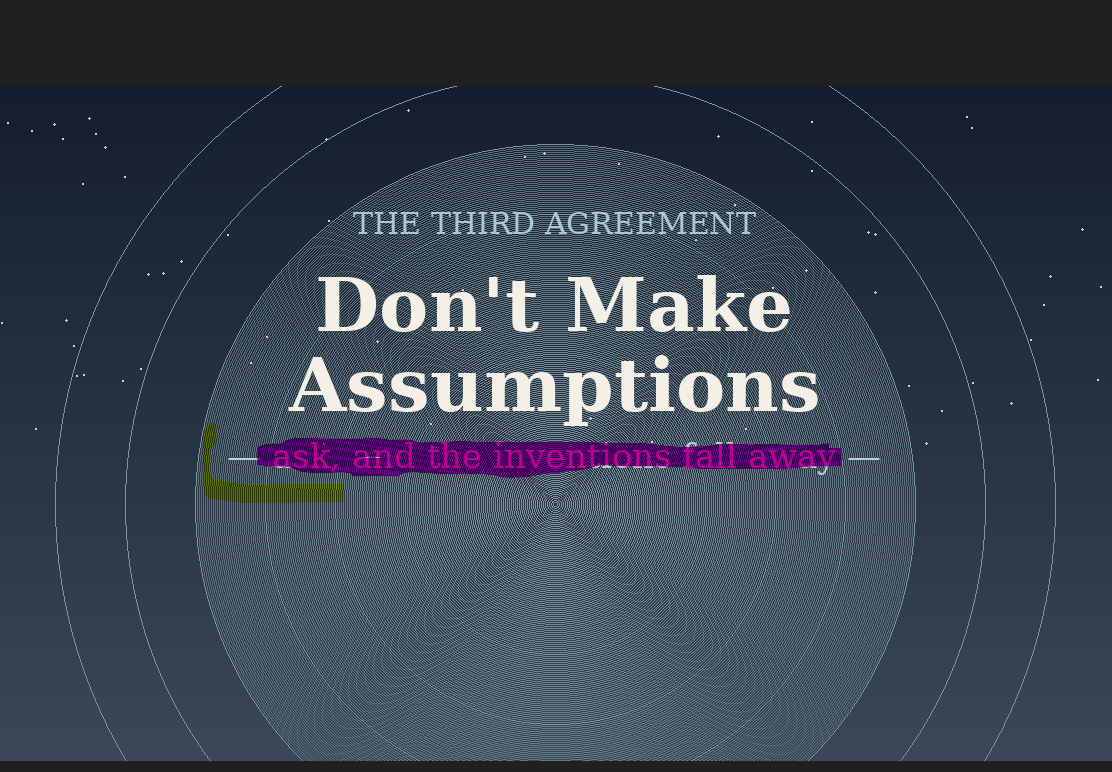
    There is a quiet violence in the assumptions we carry. They arrive unannounced, dressed as certainty, and we rarely think to question them. Don Miguel Ruiz, in The Four Agreements, names this clearly in his Third Agreement: Don’t make assumptions. And the more I sit with it, the more I see how much of our suffering — the small daily ache and the larger ruptures — begins here.

    The trouble with an assumption is that we mistake it for truth. We could swear it is real. We decide what someone meant, what they felt, what they intended, and then we react to the story we invented rather than to the person in front of us. We misunderstand, we take it personally, and we manufacture a whole drama for nothing. Ruiz is unsparing about this: most of the sadness we have lived was rooted in assuming, and then taking that assumption to heart.

    What strikes me most is why we do it. The mind hates an open question. It needs to explain, to justify, to fill the silence with an answer — and it does not much care whether the answer is correct. Any answer makes us feel safe. So we guess, and we believe our guess, and then we defend it as though our life depended on it.

    Why we stop asking

    Here I find myself looking back at my own childhood. Like many of us, I grew up in a world where asking too many questions was quietly discouraged — curiosity made the adults uncomfortable, and so we learned to stop asking and start assuming instead. That habit does not leave you when you become an adult. It hides. It becomes second nature.

    When I later came to understand these Toltec ideas, something clicked. I realised that nearly every assumption I made came from one of two failures: either I hesitated to ask the question, or I never developed the communication to draw out a real answer. The fix was never in thinking harder. It was in asking.

    So I made it a practice. I refuse, as best I can, to take things personally, and I refuse to let an assumption stand where a question would do. When I do not understand, I ask — again and again — until the picture is clear. It is uncomfortable at first. Asking can feel like exposure. But it is far less costly than the suffering an unspoken assumption creates.

    The courage to communicate

    This is why I have become such an advocate for clear, transparent expression. With my family, my friends, my peers, I encourage the same: say what you mean, ask what you don’t know, make your wants visible rather than hoping to be read like a book. So much heartbreak in relationships comes from the silent expectation — you should have known — when the truth is, we never said.

    Ruiz reminds us that everyone has the right to ask, and everyone has the right to answer yes or no. There is freedom in that simplicity. Find your voice to ask for what you want. Once you hear the answer, you no longer need to invent one.

    Clear communication is not a small thing. Ruiz believed that if all of us could speak this way — without poison, without assuming — there would be no wars, no needless conflict. I believe it too, at the scale of a single conversation. The word becomes impeccable when it stops carrying our inventions.

    The seed is the idea. The transformation is the action — repeated until it becomes who you are.


    So here is my question for you, and I’d love your honest reflection:

    When was the last time an assumption cost you something — and what question, asked in time, might have saved it?

  • The Midlife Squeeze: Why Your 40s Feel Like a Vice Grip — and How to Break Free

    By your 40s, life can feel like it’s conspiring against your happiness.

    You’re working 60-hour weeks just to keep pace.
    Your kids need money, your ageing parents need care.
    Your energy is stretched so thin it feels like you’re running on fumes — and yet, this is the very decade when you’re expected to be at your strongest.

    This isn’t just a personal feeling. The data is grim: across 132 countries, life satisfaction bottoms out in the late 40s. You are more stressed, more tired, and more financially squeezed than at almost any other stage of life.

    Welcome to the sandwich generation. Nearly 47% of adults in their 40s and 50s are supporting both ageing parents and growing children. You are the bridge between two generations — and the weight is crushing.

    Meanwhile, your career is under maximum pressure. This is your last big window to build wealth before retirement. The stakes are high, but the cost is often your brain health: chronic stress literally shrinks the parts of the brain responsible for decision-making.


    Have you heard of Ray Dalio? I hadn’t either — until someone shared his story with me. That conversation sparked my curiosity and led me to dive into his work. Here’s a crisp summary of what I learned and the key insights that stood out.

    In 1982, hedge fund founder Ray Dalio hit the wall.

    A massive prediction went wrong, nearly killing his company. He lost money, credibility, and confidence — all in one blow.

    Most people would have quit. Dalio didn’t.
    Instead, he built something new: The Leverage Principle.

    The idea was simple but radical:

    Don’t work harder — multiply your output.

    Dalio engineered his work so that 1 hour of his time produced the impact of 50 hours. That shift transformed his struggling hedge fund into Bridgewater Associates, a $150B giant.


    Dalio’s 4 Leverage Strategies for Surviving Midlife Pressure

    1. Mental Clarity through Meditation
    Dalio starts each day with 20 minutes of transcendental meditation.
    Why? It cuts cortisol (the stress hormone) by up to 30% and quiets mental noise. When your inner world feels chaotic, clarity becomes your most powerful form of leverage.

    2. Relationship Optimization
    The longest-running Harvard happiness study is clear: good relationships keep us healthier and happier.
    Dalio conducts “relationship audits,” focusing only on people who energize him.
    In midlife, it’s not how many people you know — it’s who lifts you up.

    3. Strategic Leverage
    Dalio uses three tools to multiply results:

    • Technology – Document once, reuse forever.
    • Principles – Codify lessons so mistakes don’t repeat.
    • People – Hire those better than you, then get out of their way.

    4. Intentional Day Design
    Dalio starts his mornings identifying 2–3 high-leverage actions and tackles them when his energy is highest.
    No more wasting prime hours on low-impact work.

    The Real Secret: Constant Recalibration

    Dalio doesn’t “set and forget.” He runs:

    • Weekly reviews – What worked? What didn’t?
    • Monthly check-ins – Are my goals still aligned?
    • Quarterly resets – Adjust course before drifting too far.

    Midlife can crush you — or it can forge you.
    The difference lies in how you manage the squeeze.

    By multiplying impact instead of multiplying hours, you protect your mind, your energy, and your relationships.
    The pressure will always be there — but you decide whether it breaks you or builds you.