The 2nd Agreement- DO NOT Take Anything Personally !

Refer to my previous blog (3 blogs down the thread) — I had started writing about the Four Agreements of life inspired by Toltec wisdom, where I wrote about the 1st agreement: “Be impeccable with your word.” I was recently not at my best of writing, and hence delayed by several months. Here goes the 2nd wisdom: “Don’t take anything personally.” Interestingly, this also ties beautifully into my earlier post “Is This Worth My Roar??” — both, in their own way, ask us to step back before reacting to the world’s noise.


Of all four agreements, this one might be the most liberating — and the hardest to actually live by. The idea is simple: whatever someone says or does is a reflection of their inner world, their wounds, their fears, their agreements with life — not a statement of truth about you. And yet, almost everything in how we’re raised teaches us the opposite. We’re trained to believe that other people’s reactions to us mean something about who we are.

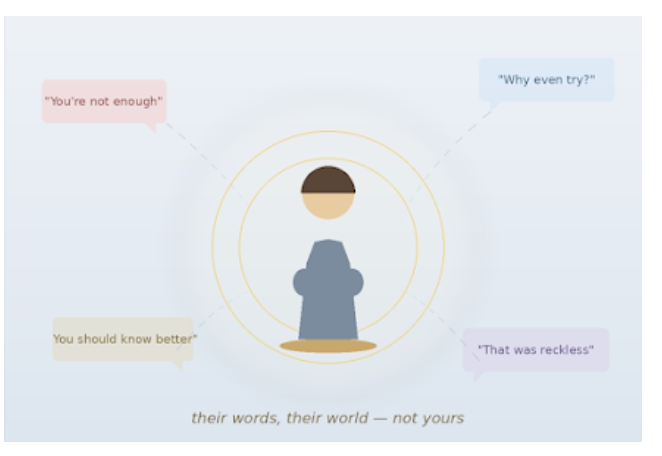
Let’s take a hypothetical exmaple through my own lens…. 🙂  Imagine you’ve recently made a significant life decision — perhaps stepping away from a stable, well-paying path to pursue something that feels more aligned with who you are. A close relative hears about it and says, with quiet disappointment, “I just don’t understand why you’d give up something so secure. After everything you worked for.” The words land heavily. You might feel a wave of doubt creep in — maybe I am being reckless, maybe I really am throwing something away.

But pause for a moment and look at where that comment is coming from. That relative may have grown up in a time or circumstance where security was everything — where stability wasn’t a choice but a survival necessity. Their reaction isn’t really about your life or your path; it’s about their relationship with fear, shaped by their own history and the agreements they made with life decades ago. When they look at your decision, they’re not seeing you clearly — they’re seeing it through the lens of their own unresolved anxieties. It’s their movie, their script, their fears playing out — you simply happened to be the screen they projected it onto.

This is where the depth of the second agreement really lives — in recognizing that everyone is dreaming their own dream, living inside their own mind, shaped by their own domestication. When someone reacts to you, they are reacting through the lens of every agreement they’ve ever made about how the world works. Their words are a mirror of their beliefs — not a window into your truth.

Here’s another hypothetical: a close friend forgets to check in during a time when you needed support. The old reflex says, they don’t care about me, I must not matter to them. But what if, instead, you considered that they’re going through something overwhelming in their own life right now — and their absence is about their own bandwidth, not your value to them? This doesn’t mean you ignore patterns or stop having honest conversations. It simply means you stop manufacturing suffering out of someone else’s distraction.

What’s beautiful about this agreement is that it applies just as much to compliments as criticism. If someone praises a decision you’ve made — “you’re so brave for doing this” — that, too, is their perception, their dream. You don’t need it to feel whole. And if someone doubts you, you don’t need to crumble or justify yourself endlessly. Either way, your sense of self stays rooted in something steadier than other people’s opinions.

When you genuinely practice this, something shifts. You stop bracing for impact in conversations, especially with family. You stop replaying things people said years ago, wondering if they were right about you. You become less reactive, more spacious — able to love people without needing them to validate your path, and able to hear hard truths without losing your footing.

Next time, I’ll continue with the 3rd agreement — “Don’t make assumptions” — which builds naturally on this one.  Until then, may you walk through your relationships a little lighter, carrying only what’s truly yours. 🙂Share

Labels

Comments

8 responses to “The 2nd Agreement- DO NOT Take Anything Personally !”

  1. Shyamali Avatar
    Shyamali

    This agreement is the best medicine for people who are overthinking everything in their lives. As an overthinker myself, I always tried to fit into the expectations of other people. I used to think it would finally make me feel like I belong to the society. But it’s side-effects are clearly stated here , as to how we overthink stuff which others may not even be conscious about. With this way of mindset, I will not lie but I am way happier and I realised that it doesn’t really matter anymore- what others think of me or what I want others to think about me.

    Liked by 1 person

    1. Abhijit Borgohain Avatar

      Thank you for sharing this so openly — it means a lot to hear how directly this lands for you. What you’ve described is exactly the trap: we spend so much energy trying to manage an image in other people’s minds, often an image they’re not even thinking about. The moment you stop carrying that weight, there’s suddenly so much more room to just be. I’m genuinely happy to hear you’re feeling that lightness already. It’s not a small shift — it’s the beginning of a much freer way of living.

      Looking forward to many more exchange of reflections going forwrad Dear Shyamali baidew/ Nupur 🙂

      Like

  2. Nishesh Avatar
    Nishesh

    To give you glimpse on how much I resonate on the topic- let me tell you that I have this exact same line pasted already in front of my desk.
    and i might remind myself this every morning, my routine surely makes me forget it by the end of the day.
    So, that much relevant this is to everyone.

    But if we go a step deeper, why would anyone make professional matter become personal and hence take it personally?

    Maybe because they take accountability and responsibility for the conclusion of task? is that wrong?
    I think they tend to forget that all the work and associated subjectivity is owned and related to ROLE that one takes in office but not him as an individual.

    It is this confusion between the role and one’s individual identity that makes it hard to nit take it personally.

    This ROLE can be any at any place, be it office, home or society.

    I think we should keep reminding ourselves first and then our dear ones that both are never same.

    Liked by 1 person

    1. Abhijit Borgohain Avatar

      I completely feel what you are going through. The biggest conundrum here is people are devoid of subtle life-senses , driven by “ gross “ life, high sense of materialism and fully captured under the “ EGO- I”m the doer “ of everything. Bhagavad Gita saying of “ कर्मण्येवाधिकारस्ते मा फलेषु कदाचन।मा कर्मफलहेतुर्भूर्मा ते सङ्गोऽस्त्वकर्मणि॥” simply becomes a theory in a paper for many 😎😁. The real challenge, is becoming too personally attached to situations and outcomes. While we should be fully present in everything we do, there is a subtle but important distinction between being present and being attached. Being present means giving our best with complete awareness and commitment. Attachment, however, entangles us emotionally with a particular result. Whenever I find myself in a difficult situation, I ask a simple question: “Is this really the end of the world if I fail?” Almost instantly, the answer brings clarity. It shifts my energy from emotional entanglement to mindful presence, allowing me to respond rather than react. Life becomes much lighter when we learn to participate wholeheartedly without being imprisoned by outcomes. 🙂

      Like

  3. Arun Tiwari Avatar

    What others say or do is largely a reflection of their own beliefs, fears, wounds, and experiences. The moment we stop making ourselves the centre of every criticism, compliment, or reaction, we reclaim our inner peace. Toltec wisdom reminds us that true strength lies not in controlling others’ opinions, but in refusing to let them define our self-worth. Keep writing Abhijit!

    Liked by 1 person

    1. Abhijit Borgohain Avatar

      Thank you Dr Arun sir — you’ve captured the Second Agreement beautifully, and it pairs so naturally with the theme of doing one’s best. When we stop taking things personally, we free up the very energy we’d otherwise spend defending ourselves, and that energy becomes available for the quiet, daily effort that actually matters. There’s real liberation in recognising that another’s reaction is their mirror, not ours to carry. Grateful for your reading and for these generous words — they encourage me to keep going.

      Like

  4. Amit Sharma Avatar
    Amit Sharma

    Really insightful post. The idea of not taking things personally is easier said than done, but a powerful reminder.

    Liked by 1 person

    1. Abhijit Borgohain Avatar

      TThank you, Amit Paaji, for taking the time to read my thoughts. 😊

      The irony of life is that most of the things we initially find boring, difficult, or demanding often become the very sources of lasting happiness, peace, and inner fulfilment when practised consistently over time. Conversely, many of the tempting, exciting, and instantly gratifying pleasures—whether in what we consume or how we spend our time—can eventually lead to discomfort or dissatisfaction.

      The choice is always ours: do we live with short-term sight or long-term vision? 🌿✨

      Like

Leave a comment