Welcome to a space where thoughts take shape, where reflections find their rhythm in words. My writings are not crafted for perfection, but for truth—they are patterns of my thoughts, echoes of inner dialogue, and responses to the ideas that move me. Influenced by my favorite topics and writers, each post is both a reflection and an exploration. I believe writing untangles the mind. In the act of putting pen to paper, confusion gives way to clarity. A pen, after all, is mightier than a sword—not because it cuts deeper, but because it reveals what lies within. These writings are my shadow—an extension of my personality, raw and real. Thank you for reading, and perhaps, for reflecting alongside me.
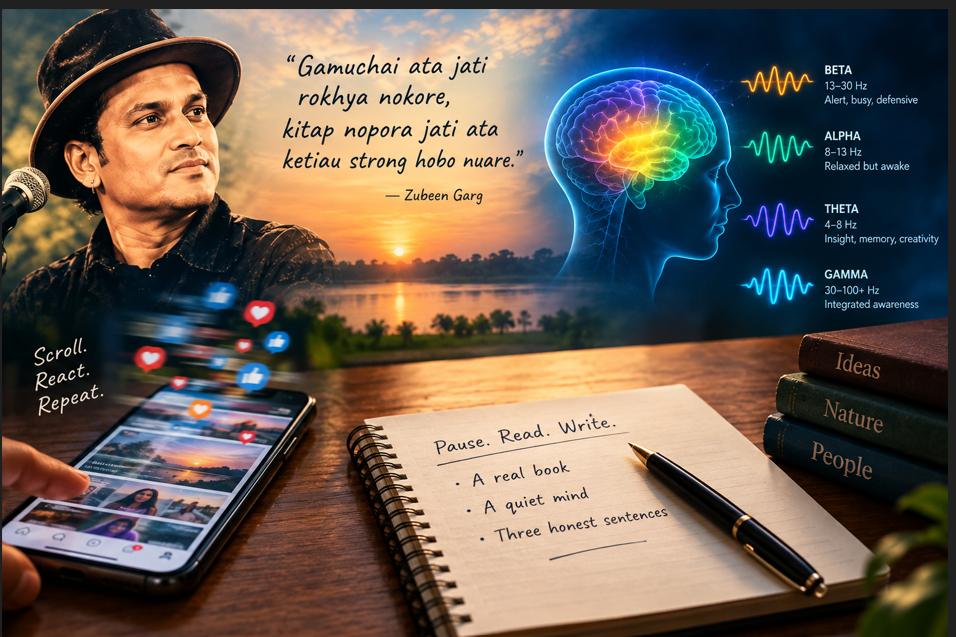
Today is the first death anniversary of Zubeen Garg. Across Assam, fans and artistes gathered at Zubeen Kshetra in Sonapur, singing his songs, closing a three-day remembrance. I remembered a line of his instead: “Gamuchai ata jati rokhya nokore, kitap nopora jati ata ketiau strong hobo nuare” — a gamusa alone will not protect a people; a nation that does not read books can never become strong.
He was not attacking the gamusa. He was pointing at the difference between wearing an identity and building one. One takes a moment. The other takes years of quiet, unglamorous attention.
Here is my own small, slightly embarrassing evidence. I have kept a blog since 2014. When I publish something I have actually thought about — a piece on the Upper Assam floods, on solitude at an ashram in Wales — the readership is modest, the comments fewer. When I post a photograph, the numbers behave completely differently. Same person, same followers, same day. The only variable is how much attention the thing demands.
I do not say this bitterly. I say it because it is a measurement, and it is measuring something in all of us, including me.
Reading a difficult page and writing an honest paragraph are the two cheapest technologies we have for thinking, and we are quietly abandoning both. The writing habit especially. A generation ago, an Assamese household had letters, diaries, notebooks, arguments in the margins of books. Now we have reactions. A reaction costs nothing, which is exactly why it buys nothing.
There is a physiology to this. Through most of a reactive day we are running in beta — alert, busy, defensive, the state of the unread notification. Slow down, breathe, sit without reaching for the phone, and the brain settles toward alpha: relaxed but awake, the state in which you can actually hear yourself. Go further — deep meditation, the trance you fall into when writing longhand and lose track of an hour — and theta appears, where insight and memory move more freely. And in long-term meditators, researchers have recorded unusually strong gamma activity, associated with vivid, integrated awareness. The sequence is not a ladder you climb once. It is a road you learn to travel, and the toll is stillness.
Reading a serious book is alpha training. Writing is theta training. Doom-scrolling is beta on a drip.
So this is my tribute today. Not a status, not a black-and-white photograph. Fifteen minutes, no phone, a real book. Then a notebook, and three honest sentences about what I actually felt — and why.
Every person carries the potential for this depth. Very few sit still long enough to find it. That, more than any algorithm, is what pains me.
Kitap nopora jati ata ketiau strong hobo nuare. Neither, I think, will a mind.
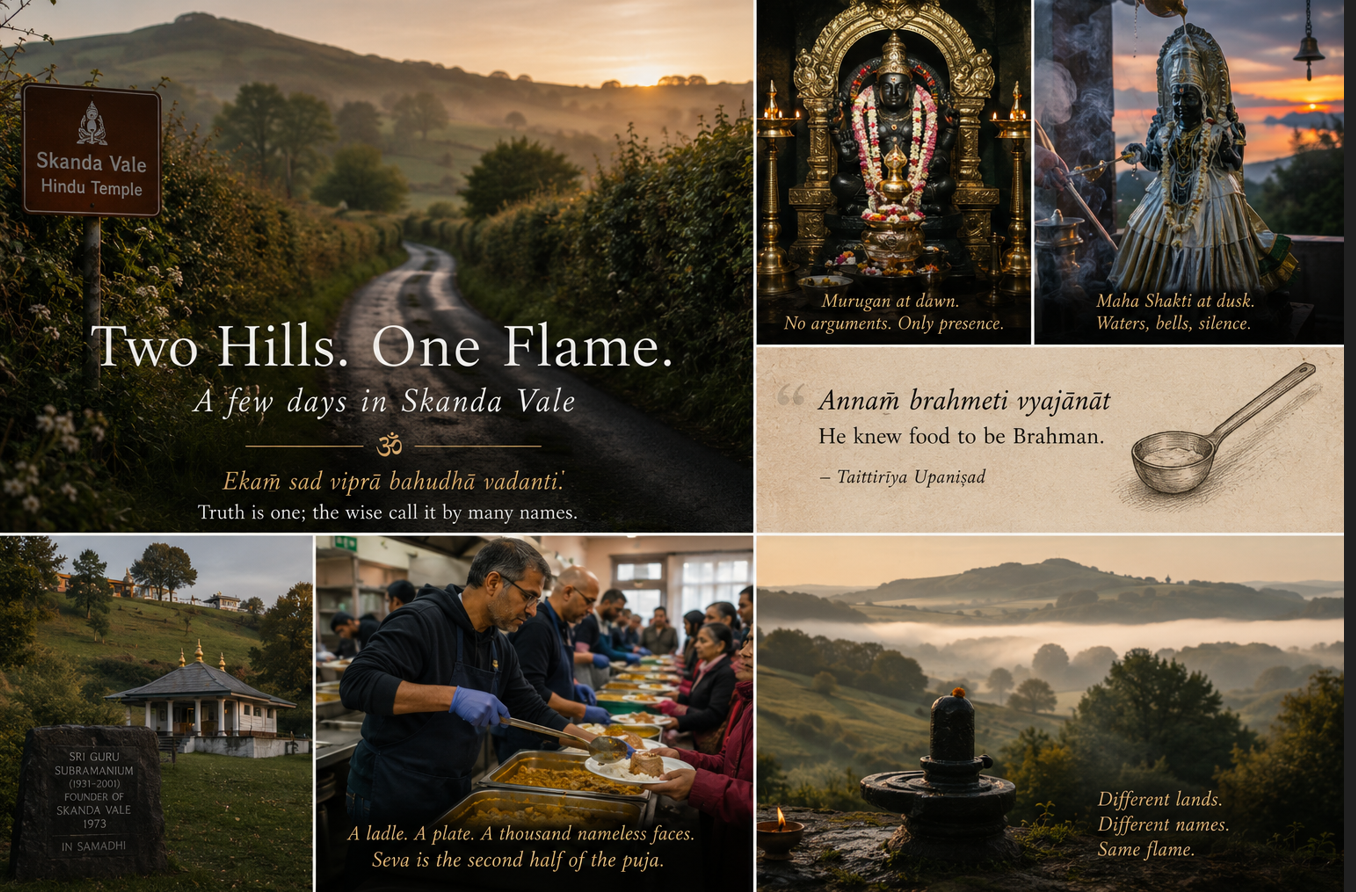
The last four miles are one lane wide. Hedgerows lean in from both sides and you slow down — not out of caution, but out of something closer to consent. Somewhere between Carmarthen and Llanpumsaint, the road stops being a road and becomes an approach.
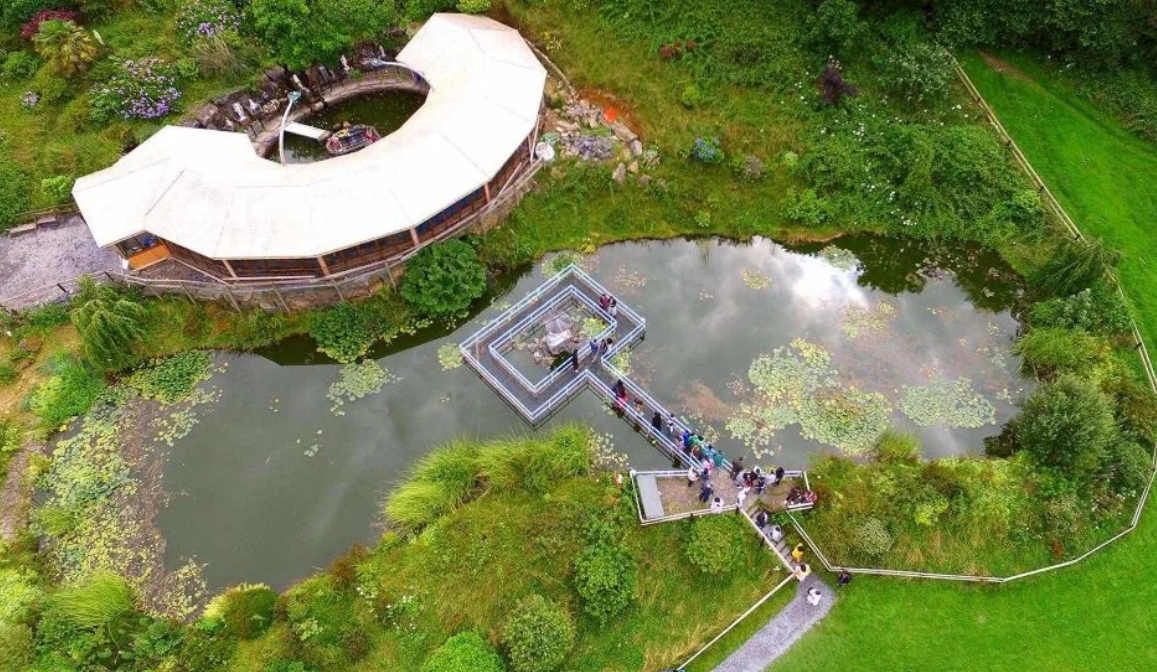
We had been here once before. A day visit — arrive with a thermos, leave before the light goes. This time we stayed. Two days, three nights: Juri, Abhiroop and I in a small room in the valley. I remember thinking we had brought far too much luggage for a place that would ask us to put things down.
There is a difference between visiting a temple and living inside its rhythm. A visit is something you do. A residence is something done to you.
Five in the morning
The day begins at an hour that has no arguments in it. The Murugan puja starts at five, and five does not negotiate — you rise or you don’t, and either way the puja happens. That indifference is its own teaching. The valley is not waiting for me to be ready.
Then, at dusk, up the hill: Maha Shakti.
Water on stone. Milk on stone. The bell, the conch, smoke lifting into cold Welsh air, and the murti standing absolutely still while everything else moved around Her. At some point during the abhishekam I stopped watching the ritual and the ritual began watching me. No vision. No light. Nothing I can hand you as evidence — only a plain certainty that arrived without argument and left no receipt: I was not in a building in Wales. Or rather, I was, and it made no difference at all.
Murugan in the dark. Mother at nightfall. By the second day I had stopped trying to tell them apart.
Abhiroop stood beside me through most of it. I explained very little. Children don’t learn devotion from explanation; they learn it from proximity — from watching what their parents go quiet in front of. Juri needed no explanation at all. She simply folded into the place, as she does.
What I recognised
Some time ago I sat at Badrika Ashram, in the Himalayan foothills. Standing in Carmarthenshire — an ocean and an entirely different mountain range away — I felt the same energy. Not a similar one. The same.
The two places share almost nothing on the surface. Different lineages, languages, landscapes, founders; Guru Sri Subramanium walked these Welsh fields from 1973 and lies in samadhi on the hillside now. Yet what pervades both is identical in texture — an absolute seriousness about the divine, held together with an absolute absence of self-importance about it. Nobody performing. Nobody selling. The work simply done, day after day, whether or not anyone is watching.
Ekaṁ sad viprā bahudhā vadanti. Truth is one; the wise call it by many names. I have quoted that line for years. Here I understood it is not a statement about tolerance. It is a statement about plumbing — about where the water actually comes from, whichever tap you happen to be standing at.
The ladle
On both days, I served food.
Weekends bring five hundred, sometimes a thousand people through this valley. Everyone is fed. Nobody pays. I stood at the counter and put food onto the plates of more than a hundred people at a stretch, and by the end of it my back ached and my mind had gone quiet in a way no cushion has ever managed.
Annaṁ brahmeti vyajānāt — he knew food to be Brahman. Not a metaphor. Rice is Brahman when it reaches the person who is hungry.
The swamis and the volunteers who have fed this valley for decades, without a line of credit to their name — they were the real darshan. The Toltec would call it impeccability: not perfection, but the refusal to do a half-hearted thing in front of God, even when the thing is a spoonful of rice for a stranger whose name you will never learn.
Coming down
We drove east on Monday. The lane widened into a road, the road into a motorway, and by Bracknell the whole thing had the texture of something that might not have happened.
I did not come home with answers. I came home with a suspicion — that the line I have quietly kept all my life between the sacred hours and the ordinary ones is not a real line, and never was. That seva is not what you do after the puja. It is the second half of the puja.
If something in this stirs you, go. Not for a day. Stay. Rise at five. Take a ladle.
See what the hills tell you. They have been saying it a long time.
There is an order to how Assam floods, and everyone raised near the Brahmaputra knows it in their body. The great river swells first, slowly, over days. There is a rhythm to it — even a terrible kind of courtesy.
This July, the water did not observe the courtesy.
Extraordinary rain fell over the hills of Mon in Nagaland — 137 millimetres in nine hours. It poured down into the south-bank tributaries, the Dikhow, the Disang, the Jhanji, and they rose in hours rather than days. They arrived in the plains before the Brahmaputra had reached its own peak, and so the Brahmaputra, still filling, would not take them. The water had nowhere to go but sideways, into the towns.
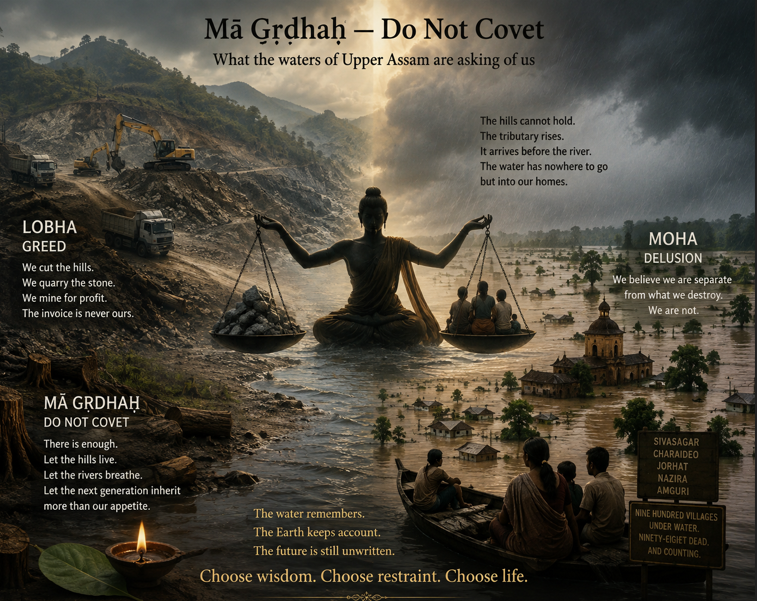
Sivasagar. Charaideo. Jorhat. Nazira. Amguri. These are not names from the flood map. These are the places that do not flood, the high ground, the old Ahom heartland. They have now seen their worst inundation in sixty years. Nine hundred villages under water. Ninety-eight dead, and the counting unfinished.
I keep returning to that inversion — the tributary arriving before the river. It feels less like a hydrological accident than a sentence spoken in a language I am only beginning to understand. The consequence arrived before we were ready for the cause.
The arithmetic of an unequal harm
Rain has been falling on those hills for as long as there have been hills. What has changed is what the hills can hold.
For two decades the upper catchments have been cut, quarried and mined. Hillsides levelled for stone, forest cleared for coal, slopes opened for aggregate. Each operation is, on its own accounting sheet, profitable. Each has an owner, a margin, a buyer. And each converts a hillside that absorbed water into a surface that sheds it, and fills the riverbed downstream with silt until the channel can no longer carry what it once carried.
So the water that killed people in Sivasagar was manufactured, in part, in a quarry in Mon, Nagaland.
And the men who made the money in Mon are not the families who lost their homes in Nazira. That is the moral centre of this disaster, and of the larger one it sits inside. The one who profits and the one who drowns are never the same person. They are rarely in the same district. Increasingly they are not in the same country.
Widen the lens and the pattern repeats at every scale. Assam’s per-capita emissions are a fraction of India’s, which are a fraction of Britain’s. The Eastern Himalaya is warming faster than the global average. The people of Charaideo contributed almost nothing to the physics now intensifying their monsoon, and they will pay for it first, and with everything they have.
In supply chains we have a name for this. We call it an externality — a cost that is real, that someone certainly pays, but that never appears on the invoice of the person who caused it. We built a global economy on the quiet assumption that the invoice would never arrive.
It arrived in Sivasagar in July.
The physics, stated honestly
No one can say that climate change caused this flood. That is not how the science works, and pretending otherwise hands ammunition to those who would rather nothing were said at all. This flood had a local, largely governance-shaped cause: extreme rain over a degraded catchment on a bad hydrological schedule.
But this can be said. We have moved atmospheric carbon dioxide from 280 parts per million to well past 420. These molecules are transparent to incoming sunlight and opaque to the heat the Earth tries to send back out. That is the whole mechanism — nineteenth-century physics, never seriously in doubt. The Earth has warmed some 1.3 to 1.5 degrees; 2024 was the first calendar year to breach 1.5. That number was never a cliff edge. It was a line drawn by people who understood that beyond it, certain processes stop being things we do to the planet and start being things the planet does to itself.
And there is one relation that matters most for Assam. For every degree of warming, the atmosphere holds roughly seven per cent more water vapour. This does not make it rain more often. It makes it rain harder when it rains — shifting precipitation out of the steady soak a hillside can absorb, into the violent burst it can only shed.
A hundred and thirty-seven millimetres in nine hours is precisely the shape of rain a warmer atmosphere makes more of.
So: climate change did not cause this flood. It is loading the dice, and we will roll them every monsoon for the rest of my son’s life and his children’s, because the carbon already aloft will still be shaping the climate a thousand years from now. That is what irreversible means. Not that the world ends. That there is no going back to the world we were given.
Lobha ( Greed) — the flood before the flood
Our tradition has a precise name for the upstream event.
The ariṣaḍvarga, (अरिषड्वर्ग) – the six enemies, are : craving, anger, greed, delusion, arrogance and envy. What the tradition insists upon — and what modern environmentalism keeps forgetting — is that these are inner phenomena with outer consequences. The hillside is not cut because of an economic model. The model exists because of lobha, and it is only ever as strong as the appetite that funds it.
The flood in Sivasagar had a flood upstream of it, and that flood was in the human heart. This is not metaphor. It is a causal chain, and every link is visible.
The Īśa Upaniṣad says in one verse what I have spent this whole essay circling:
All this is pervaded by the Divine. Enjoy it, therefore, through relinquishment. Do not covet — for whose is wealth?
Notice: it does not say do not enjoy. Bhuñjīthā — enjoy — but tena tyaktena, by way of letting go. Take, but not as an owner. The world is on loan, not on title. Our civilisation read the first half of that sentence and tore out the second.
The Gītā then makes the same thought hydrological: beings arise from food, food from rain, rain from yajña (3.14). Yajña is badly translated as sacrifice, which in English became a word about loss. It is not about loss. It is reciprocity — that whatever you draw from a system must be answered by something returned. Krishna’s next verse is blunt: one who takes from this circulation and gives nothing back is a thief.
We took the carbon and returned nothing. We took the hillside and returned nothing. We broke the yajña, and the rain answered exactly as the verse said it would.
Let me be careful here. There is a crude version of karma abroad that would say Sivasagar somehow earned this. That is not karma; it is cruelty wearing a Sanskrit word. Karma is causality, not retribution — and our tradition distinguishes the individual’s from the collective’s. The tragedy of collective karma is precisely that it does not ripen where it was sown. A civilisation acts; a village pays. That is not justice. It is simply the shape of the thing, and knowing the shape is where action begins.
What, then, does one person do
I have no ending that resolves this, and I distrust essays that do. But I have three things.
Give now. Philosophy is not what a family in a relief camp in Amguri needs this week. They need rice, tarpaulin, clean water, cash. Give money first and think about cosmology afterwards; reversing that order is a species of spiritual vanity, and I include myself in the warning.
Aparigraha. Non-hoarding — the personal-scale form of mā gṛdhaḥ. Not asceticism, just the unglamorous daily interrogation of appetite: do I need this, or have I merely been taught to want it? It changes nothing in the atmosphere. It changes everything in the person — and people are what atmospheres are made of.
Dharma in the work. Whatever your trade, ask what the world needs from precisely what you already know how to do. Expertise built inside a misaligned system is not disqualified from changing it. It may be the only real qualification there is.
The Dikhow has begun to fall. The silt lies a foot deep in houses where children were doing their homework three weeks ago. Somewhere in the hills above, a quarry is reopening.
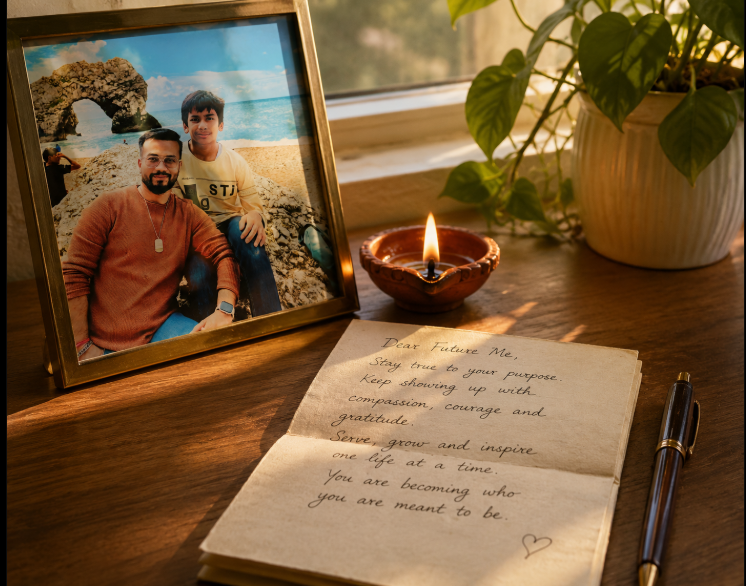
Last night I stood at your door longer than I meant to. You were asleep in that way only children sleep — completely, without negotiation, as if tomorrow were somebody else’s problem. And I thought of a question you asked me a few weeks ago, casually, the way you ask everything: “Bubui, do you like your work?”– (He lovingly address me as Bubuii 🙂 )
I gave you an answer that was true enough for a child. This letter is the answer that is true enough for a man. I am writing it now, while you are small, for you to read when you are perhaps twenty-five — old enough to have your own furnished rooms, your own offer letters, your own quiet three a.m. questions. Fold it away. It will keep.
One. Success can be a beautifully furnished room with no windows.
For many years I was, by every measure the world keeps, doing well. I flew between continents. I negotiated in boardrooms from Shanghai to Brussels. And somewhere in the middle of all that motion, I stopped being able to say why I was doing any of it.
Nobody warns you about this, so I will: the room gets more comfortable every year. The furniture improves. And the window you keep meaning to look for gets quietly papered over by the next appraisal, the next bonus, the next flight.
One day a salary and a title will ask you, very politely, to stop asking questions. Don’t. Being valued and being aligned are not the same thing, and the difference between them is the difference between a career and a life.
Two. It is never too late to become a student again.
This year — the year I am writing this — I did something that would have embarrassed the younger me. In my mid-forties, twenty years into being the expert in most rooms I entered, I signed up as a complete beginner. New certificates in subjects that didn’t exist when I studied. An eight-week course where I sit with strangers and learn, of all things, how to breathe.
Here is what I learned before I learned anything on the syllabus: expertise is a house, but curiosity is the door. A house without a door becomes, eventually, a tomb — well-built, admired, sealed.
You will one day be the most experienced person in a room and feel the smallness of it. When that happens, go and find a room where you are the least experienced person. It is uncomfortable in exactly the way growing is uncomfortable.
Three. Give something back to the ground you stand on.
I began my working life in laboratories, coaxing chemistry into foams and materials — making things. It took me two decades to hear the other half of that sentence: everything made is made from something, and the Earth keeps honest accounts even when we don’t.
So the second half of my working life is being given to the repair — to sourcing and materials that take less and return more. Not because it is fashionable, but because I finally understood something our tradition tried to teach me all along: work becomes worship the moment it serves something larger than the worker. The Gita calls it yajna. I call it, some mornings, simply being able to look at you without flinching.
Whatever you choose to do — and I genuinely do not mind what it is — ask of it one question: what does this give back? If the honest answer is “nothing,” you have found employment. Keep looking for work.
Four. Build the temple before the storm.
Every morning, before the house wakes, I sit. A lamp, a mantra, a silence you have occasionally wandered into, rubbing your eyes, wondering why Baba is talking to nobody. I am not talking to nobody. I am keeping an appointment.
I did not build this practice because life was hard. I built it while things were ordinary, so that when things stopped being ordinary — and they always, eventually, stop — there was somewhere to stand. The inner life is not a luxury for people with spare time. It is load-bearing. Nobody sees the foundation of a house, and the house stands because of it.
Find your own form of this. It needn’t look like mine — mantra, prayer, breath, a walk taken in silence, it hardly matters. What matters is that it is daily, and that it is yours, and that you build it before you need it.
Now let me imagine you, since a letter to the future is allowed one act of imagination.
You are twenty-five. You are in a city I have never seen, in a flat I will tease you about, holding an offer letter that pays extremely well for work that means almost nothing to you. Everyone around you is congratulating you. Something small and stubborn in your chest is not.
I know that room, Abhiroop. I furnished it for years.
I cannot tell you what to do in it — perhaps you take the offer, perhaps you don’t; there are seasons for both, and I took mine too. I ask only this: hear the small stubborn thing out. Give it ten quiet minutes before the noise of congratulations drowns it. It is not your enemy. It is the most honest advisor you will ever employ, and it works for free.
These are not instructions. You are not obliged to any of it — not my lessons, not my path, not even this letter. Burn it if you must. But if you burn it, light something with the flame.
And if you are not Abhiroop — if you have simply wandered this far down a stranger’s letter — then perhaps a line or two of it was addressed to you as well. Letters have a way of finding their true recipients. That, too, is something I’ve stopped being surprised by.
With more love than these paragraphs could carry, Yours lovingly- Bubui ( Dady)
There is a bird tattooed on my hand. A phoenix. People sometimes ask what it means, and I give them the short answer — rising from the ashes — because the long answer takes a lifetime, and I am still living it.
This is not a story with an ending. Transformation, I’ve learned, is not a door you walk through once. It is more like a river that keeps arriving at the sea, remaking itself with every bend. What follows is simply a report from somewhere along the current.
The Child Who Listened to the Old
Some children run toward the playground. I was the one drifting toward the veranda where the elders sat. I have always felt a strange gravity toward the subtle — the unsaid thing beneath the said thing, the weather behind a person’s eyes. While others collected marbles, I was collecting impressions: a sense of self that arrived early, an emotional and cognitive empathy that let me feel the room before I understood it.
My mother gave me my first compass. In her devotional life, I saw that the sacred was not a Sunday event but a daily posture. By fourteen or fifteen, I was reciting Sanskrit shlokas to Lord Shiva — not as homework, but as hunger. By nineteen or twenty, that hunger became surrender. I still remember tears arriving unbidden during remembrance of my deity, the kind of tears that don’t belong to sadness at all. They were the overflow of something too large to hold.
The Garden Had Thorns
But the same garden that grew that devotion was full of thorns.
My high-school years were a siege of the body — recurrent fevers, month after month; a frame that was short, weak, feeble against the tall confidence of my peers. And there were disturbances of another order altogether — paranormal, psychic interferences that I understood later were not misfortune but intention. Harm was directed at me and at my family through the darker crafts, the kind that work in shadow. I say this plainly, though I will not name it further in public; some knowledge is best held, not paraded.
For a long time I did not understand what was happening. But truth has a nature of its own: it never truly hides. It may arrive late — years late — but it always surfaces, the way a stone dropped in a well eventually shows its ripple. In time I came to know who the internal enemy was, the one who moved against us from close quarters. An inferiority complex took root in that soil, as such things do.
And here is the part I hold with quiet awe: I did not have to lift a finger. I watched Mother Nature — call it karma, call it dharma, call it the long arithmetic of the cosmos — settle the account herself. Those who set the fire were, in time, consumed by their own. I witnessed it. Not with triumph, but with a chastened understanding that the universe keeps its own ledger, and no debt goes unrecorded.
Even so — thorns are not the whole plant. Even then, good results at school earned me a quiet reputation, the respect of teachers, the trust of friends. Looking back, I see that the fever and the respect grew on the same stem. The wound and the gift were never separate. The oyster does not choose the grain of sand, but it decides what to build around it.
The Turn After the Twenties
Something shifted in my mid-twenties. The seed of bhakti planted so early finally cracked open and grew roots deep enough to hold weight — enough for a 360-degree turn.
I often feel I am two people walking together: an inner guru and the sevak who follows him. Astrologically, this is written into my very chart — Jupiter and Saturn sit together in my first house, conjunct with my ascendant, the two great forces standing at the doorway of who I am. Jupiter, teacher of dharma; Saturn, relentless disciplinarian of karma. One points to the ideal; the other insists you earn it, slowly, in the currency of effort. Between the two, a life gets built.
Why the Phoenix
I chose the phoenix because I have, quite literally, felt the jaws of death close and then loosen. When you survive that, you stop negotiating with life for comfort and start asking it for meaning.
Here is what I now hold as bedrock: life is uncertain, death is certain — and death is not a wall but a door. A threshold where prarabdha karma is carried forward, like a traveller changing trains but keeping the same luggage. If that is true, then how I live matters — not for reward, but because every action is a stitch in a garment I will wear again.
So I choose consciousness over surface. Courage over comfort. And when I fall — I will fall, that is not in question — I choose to rise. Not because the ashes are pleasant, but because I have felt, more than once, what waits in the rising.
The transformation continues. I would not want it any other way.
And you? Somewhere in your own story there is a grain of sand you’ve been building around — a thorn that became a stem, a fall you’re still learning to rise from. I’d love to hear where you are on your own river. Leave a comment, share this with someone walking a similar path, or simply sit with the question tonight: what is your fire teaching you to become?
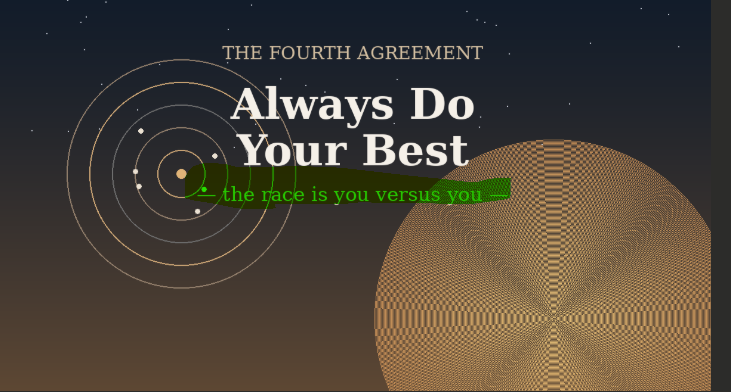
There is one more agreement in Don Miguel Ruiz’s The Four Agreements, and it is the one that breathes life into the other three. Always do your best. Without it, the first three remain beautiful ideas — words on a page. With it, they become how you live.
What I love about this agreement is its honesty. Ruiz is careful to say your best is never fixed. It changes from morning to night, from health to sickness, from a calm heart to a troubled one. Your best when you wake rested is not your best when you are exhausted, and that is perfectly fine. The agreement is not “always be excellent.” It is “always do your best — no more, no less.” Do more, and you burn out, going against yourself. Do less, and you hand yourself over to guilt and regret.
For a long time, I missed this entirely. I was a day-dreamer. I lived in elaborate plans, rehearsing futures in my head, refining and re-refining the perfect approach before I had taken a single step. Planning felt like progress. It was not. It was a comfortable hiding place — analysis dressed up as preparation, paralysis dressed up as care.
Aim, then shoot
The shift came when I understood something simple: action brings clarity that thinking never can. You can analyse a problem for months and still not see what one honest attempt reveals in an afternoon.
I now hold an analogy close in my own life. The old me wanted to aim, and calculate, and adjust, and perfect the shot — and somewhere in all that calculating, never actually shoot. The evolving me has learned to aim and then shoot. Then aim and shoot again. And again. The first shots will miss. They are supposed to. But each one teaches the next, and over time the aim sharpens through doing, not through deliberating. Precision is the reward of repetition, not of waiting for the perfect moment that never arrives.
This is exactly what Ruiz means. He tells the story of the man who asks a Master how long he must meditate to transcend. Eight hours a day, the Master says, will take him longer than two — because he will only grow tired, miss the point, and forget to live. The lesson is not to grind yourself into the ground chasing perfection. It is to act with full presence, then let the doing teach you.
The race is you versus you
Here is the reframe that changed me most: the race was never against anyone else. It is you versus the person you were yesterday. Be a slightly better version today — that is the whole game. Not perfect. Better. And tomorrow, better again.
When you measure yourself this way, the Judge loses its grip. Ruiz puts it plainly — when you have truly done your best, the Judge has nothing to convict you with. You have your answer: I did my best. No regret, no self-punishment. And freed from that fear, you stop needing the perfect conditions to begin.
So I have made peace with imperfect action. I take small steps now — small, almost unglamorous steps — every single day toward the larger things I want. A page written. A conversation had. One shot taken. None of them feels like much in isolation. But Ruiz reminds us that everything we have ever mastered, we mastered through repetition. We learned to walk, to write, to speak our language, by doing it badly and continuing anyway. Practice makes the master. Action is what makes the difference.
The plans I once mistook for progress have given way to something humbler and far more alive: showing up, doing my best for that day, and trusting the accumulation. Some days my best is brilliant. Some days it is barely enough. I no longer judge the difference. I just keep shooting.
If you fall, Ruiz says, do not give the Judge the satisfaction. Stand up and begin again tomorrow. Today is the beginning of a new dream.
So I’ll leave you with the question I keep asking myself:
What is one small action you’ve been endlessly planning — and what would happen if you simply took the shot today, imperfect and all?
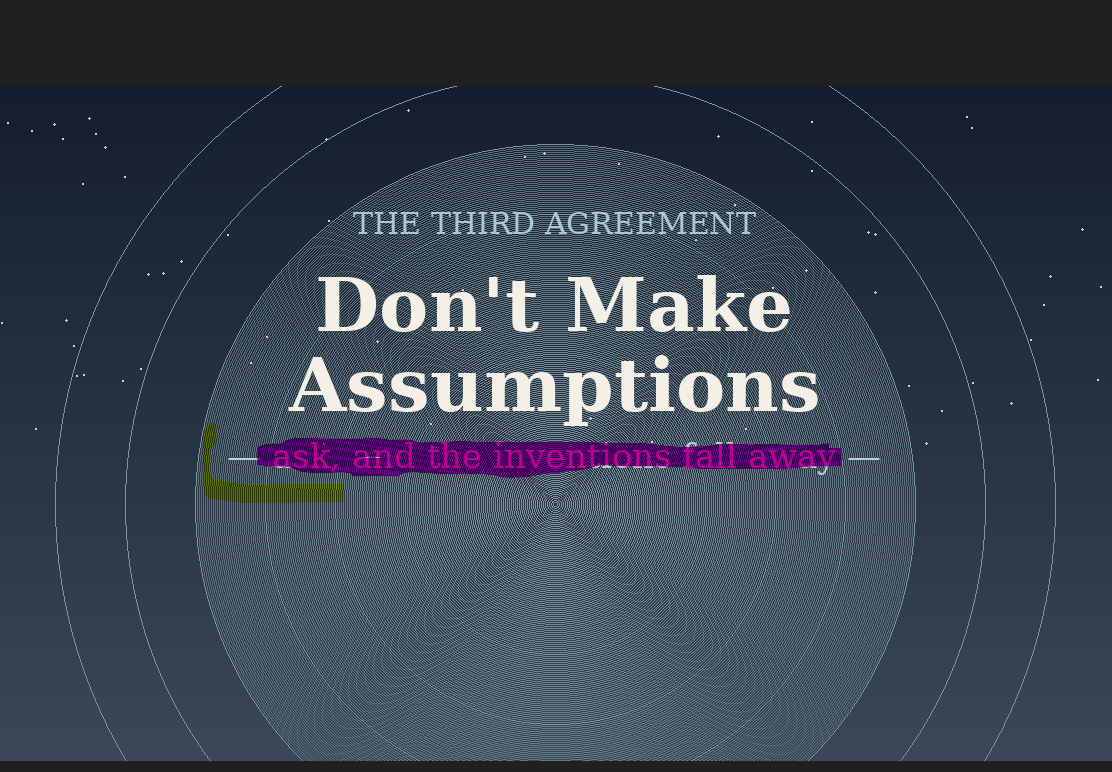
There is a quiet violence in the assumptions we carry. They arrive unannounced, dressed as certainty, and we rarely think to question them. Don Miguel Ruiz, in The Four Agreements, names this clearly in his Third Agreement: Don’t make assumptions. And the more I sit with it, the more I see how much of our suffering — the small daily ache and the larger ruptures — begins here.
The trouble with an assumption is that we mistake it for truth. We could swear it is real. We decide what someone meant, what they felt, what they intended, and then we react to the story we invented rather than to the person in front of us. We misunderstand, we take it personally, and we manufacture a whole drama for nothing. Ruiz is unsparing about this: most of the sadness we have lived was rooted in assuming, and then taking that assumption to heart.
What strikes me most is why we do it. The mind hates an open question. It needs to explain, to justify, to fill the silence with an answer — and it does not much care whether the answer is correct. Any answer makes us feel safe. So we guess, and we believe our guess, and then we defend it as though our life depended on it.
Why we stop asking
Here I find myself looking back at my own childhood. Like many of us, I grew up in a world where asking too many questions was quietly discouraged — curiosity made the adults uncomfortable, and so we learned to stop asking and start assuming instead. That habit does not leave you when you become an adult. It hides. It becomes second nature.
When I later came to understand these Toltec ideas, something clicked. I realised that nearly every assumption I made came from one of two failures: either I hesitated to ask the question, or I never developed the communication to draw out a real answer. The fix was never in thinking harder. It was in asking.
So I made it a practice. I refuse, as best I can, to take things personally, and I refuse to let an assumption stand where a question would do. When I do not understand, I ask — again and again — until the picture is clear. It is uncomfortable at first. Asking can feel like exposure. But it is far less costly than the suffering an unspoken assumption creates.
The courage to communicate
This is why I have become such an advocate for clear, transparent expression. With my family, my friends, my peers, I encourage the same: say what you mean, ask what you don’t know, make your wants visible rather than hoping to be read like a book. So much heartbreak in relationships comes from the silent expectation — you should have known — when the truth is, we never said.
Ruiz reminds us that everyone has the right to ask, and everyone has the right to answer yes or no. There is freedom in that simplicity. Find your voice to ask for what you want. Once you hear the answer, you no longer need to invent one.
Clear communication is not a small thing. Ruiz believed that if all of us could speak this way — without poison, without assuming — there would be no wars, no needless conflict. I believe it too, at the scale of a single conversation. The word becomes impeccable when it stops carrying our inventions.
The seed is the idea. The transformation is the action — repeated until it becomes who you are.
So here is my question for you, and I’d love your honest reflection:
When was the last time an assumption cost you something — and what question, asked in time, might have saved it?
Refer to my previous blog (3 blogs down the thread) — I had started writing about the Four Agreements of life inspired by Toltec wisdom, where I wrote about the 1st agreement: “Be impeccable with your word.” I was recently not at my best of writing, and hence delayed by several months. Here goes the 2nd wisdom: “Don’t take anything personally.” Interestingly, this also ties beautifully into my earlier post “Is This Worth My Roar??” — both, in their own way, ask us to step back before reacting to the world’s noise.
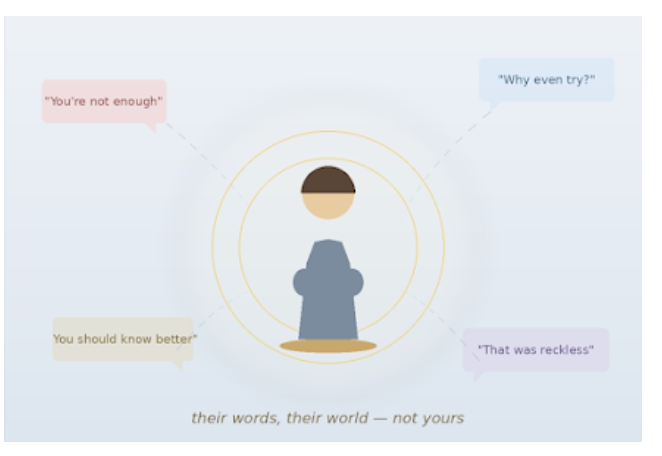
Of all four agreements, this one might be the most liberating — and the hardest to actually live by. The idea is simple: whatever someone says or does is a reflection of their inner world, their wounds, their fears, their agreements with life — not a statement of truth about you. And yet, almost everything in how we’re raised teaches us the opposite. We’re trained to believe that other people’s reactions to us mean something about who we are.
Let’s take a hypothetical exmaple through my own lens…. 🙂 Imagine you’ve recently made a significant life decision — perhaps stepping away from a stable, well-paying path to pursue something that feels more aligned with who you are. A close relative hears about it and says, with quiet disappointment, “I just don’t understand why you’d give up something so secure. After everything you worked for.” The words land heavily. You might feel a wave of doubt creep in — maybe I am being reckless, maybe I really am throwing something away.
But pause for a moment and look at where that comment is coming from. That relative may have grown up in a time or circumstance where security was everything — where stability wasn’t a choice but a survival necessity. Their reaction isn’t really about your life or your path; it’s about their relationship with fear, shaped by their own history and the agreements they made with life decades ago. When they look at your decision, they’re not seeing you clearly — they’re seeing it through the lens of their own unresolved anxieties. It’s their movie, their script, their fears playing out — you simply happened to be the screen they projected it onto.
This is where the depth of the second agreement really lives — in recognizing that everyone is dreaming their own dream, living inside their own mind, shaped by their own domestication. When someone reacts to you, they are reacting through the lens of every agreement they’ve ever made about how the world works. Their words are a mirror of their beliefs — not a window into your truth.
Here’s another hypothetical: a close friend forgets to check in during a time when you needed support. The old reflex says, they don’t care about me, I must not matter to them. But what if, instead, you considered that they’re going through something overwhelming in their own life right now — and their absence is about their own bandwidth, not your value to them? This doesn’t mean you ignore patterns or stop having honest conversations. It simply means you stop manufacturing suffering out of someone else’s distraction.
What’s beautiful about this agreement is that it applies just as much to compliments as criticism. If someone praises a decision you’ve made — “you’re so brave for doing this” — that, too, is their perception, their dream. You don’t need it to feel whole. And if someone doubts you, you don’t need to crumble or justify yourself endlessly. Either way, your sense of self stays rooted in something steadier than other people’s opinions.
When you genuinely practice this, something shifts. You stop bracing for impact in conversations, especially with family. You stop replaying things people said years ago, wondering if they were right about you. You become less reactive, more spacious — able to love people without needing them to validate your path, and able to hear hard truths without losing your footing.
Next time, I’ll continue with the 3rd agreement — “Don’t make assumptions” — which builds naturally on this one. Until then, may you walk through your relationships a little lighter, carrying only what’s truly yours. 🙂Share
When I was a kid, around six or seven, I remember being utterly enchanted by a children’s magazine called Tinkle. Where Chandamama, Balhans, Parag, Nandan, and Lotpot were all wonderful in their own ways, Tinkle felt like it belonged to a different league altogether. It wasn’t easily available in our town, so I used to walk to the library just to read it. Even now, I can’t quite believe how, with his modest means, my father managed to get me subscriptions to every children’s magazine I ever wanted. Comics were negotiable, but magazines—those he never said no to. They arrived tucked inside the morning newspaper, and the anticipation of unfolding the paper to see whether today was the day was a joy like no other.Perhaps that’s why, even today, I still read Tinkle on my Kindle. It takes no more than a few minutes, but whenever I open my Kindle, I somehow end up opening Tinkle first. And the other day, I came across a story that stayed with me.A lion was walking through the forest with his young cub when a rabid dog suddenly appeared, barking and snarling. The lion didn’t even turn his head. He simply walked on, majestic and unbothered. After a while, the cub asked, “Papa, you are the king of the jungle. Why didn’t you teach him a lesson?”The lion stopped and said gently, “What glory is there in defeating a mad dog? Tomorrow, the animals won’t say, ‘There goes the mighty lion.’ They’ll say, ‘There goes the lion who fought a rabid dog.’”We live in a world full of barking dogs—snide comments on social media, curt remarks from relatives, strangers eager to pick a fight, old friends who have become old wounds. Most of them aren’t even rabid; they’re simply bored, hurting, or hungry for attention.The question is rarely can we respond. Of course we can. The real question is: should we? And what will it cost us?Every battle, even the ones we win, takes something from us—time, energy, sleep, peace. A part of us lingers on that battlefield long after the fight is over, replaying the scene, sharpening retorts for next time. If the prize isn’t worth the price, then we haven’t won; we’ve only lost more slowly.Nasrudin once said, when told that a butcher had insulted him, “When a dog barks at the moon, does the moon bark back?” The dog tires itself out. The moon keeps shining.Life will always have its butchers, its mad dogs, its kicking donkeys. They are part of the scenery. Our task is not to silence them but to remember who we are in their presence.I’m not suggesting withdrawal or passivity. I’m saying: pick your battles. Fight for something worthy—your dharma, your loved ones, your purpose, your awakening. Suffer, if you must, for something magnificent.Before you let anything unravel you, pause and ask yourself: is this worth my roar?
Once upon a time, Americans drove what could only be described as land yachts.
These were not just cars—they were statements. Massive in size, often as large as small trucks, these vehicles defined the automotive culture of the 1950s through the early 1970s. Inside, they were drenched in luxury—leather, wood, chrome, plush carpets, and glass. Comfort, status, and opulence mattered far more than efficiency.
Under the hood, these machines carried enormous V8 engines—5 to 7 litres in size. Yet, despite their scale, they were not particularly efficient or powerful by today’s standards. Fuel consumption was high, but few cared. Petrol was cheap, and abundance was taken for granted.
Dominated by the “Big Three”—Ford, General Motors, and Chrysler—the American automotive industry thrived on this philosophy.
Meanwhile, Japanese automakers quietly entered the US market with a very different approach. Their cars were small, simple, fuel-efficient, and affordable. At the time, they were dismissed as “toy cars” and struggled to gain acceptance.
Then came 1973.
The world was shaken by the oil crisis, triggered by geopolitical tensions during the Yom Kippur War. In response to US support for Israel, Arab members of OPEC cut off oil supplies to the United States and other Western nations.
The impact was immediate and dramatic.
Fuel prices surged nearly fourfold. Petrol, once cheap and abundant, became scarce and rationed. Long queues formed at petrol stations. People waited hours for limited fuel. The government imposed a national speed limit of 55 mph to conserve energy. Even public buildings reduced lighting to set an example.
For the first time, Americans were forced to confront a new reality—fuel was not infinite.
This shift changed everything.
Suddenly, the appeal of large, fuel-hungry land yachts faded. Consumers began to value efficiency, reliability, and affordability—the very strengths of Japanese cars.
What was once dismissed became desirable.
Over the next two decades, Japanese automakers like Toyota and Honda steadily gained market share. While American brands remained strong, their dominance was no longer absolute. The monopoly had been broken.
The oil crisis did more than disrupt fuel supply—it reshaped consumer behaviour, industrial strategy, and global competition.
1973 vs Today
There are echoes of 1973 in today’s world, with geopolitical tensions again influencing energy markets. However, key differences exist.
Today, global oil supply is far more diversified. The United States itself is now one of the largest producers. Other major contributors include Saudi Arabia, Russia, Canada, and China. Unlike the 1970s, supply is no longer concentrated in a few regions.
Additionally, the world now relies on a broader energy mix—natural gas, nuclear power, and renewables reduce dependence on crude oil alone.
While oil prices remain volatile, the likelihood of a sudden fourfold spike, as seen in 1973, is lower in today’s competitive and diversified market.
Final Reflection
1973 was not just an energy crisis—it was a wake-up call.
It taught industries and nations a fundamental lesson: efficiency, resilience, and diversification are not optional—they are essential.
And perhaps, in a different form, that lesson still echoes today.