Three nights at Skanda Vale https://www.skandavale.org/
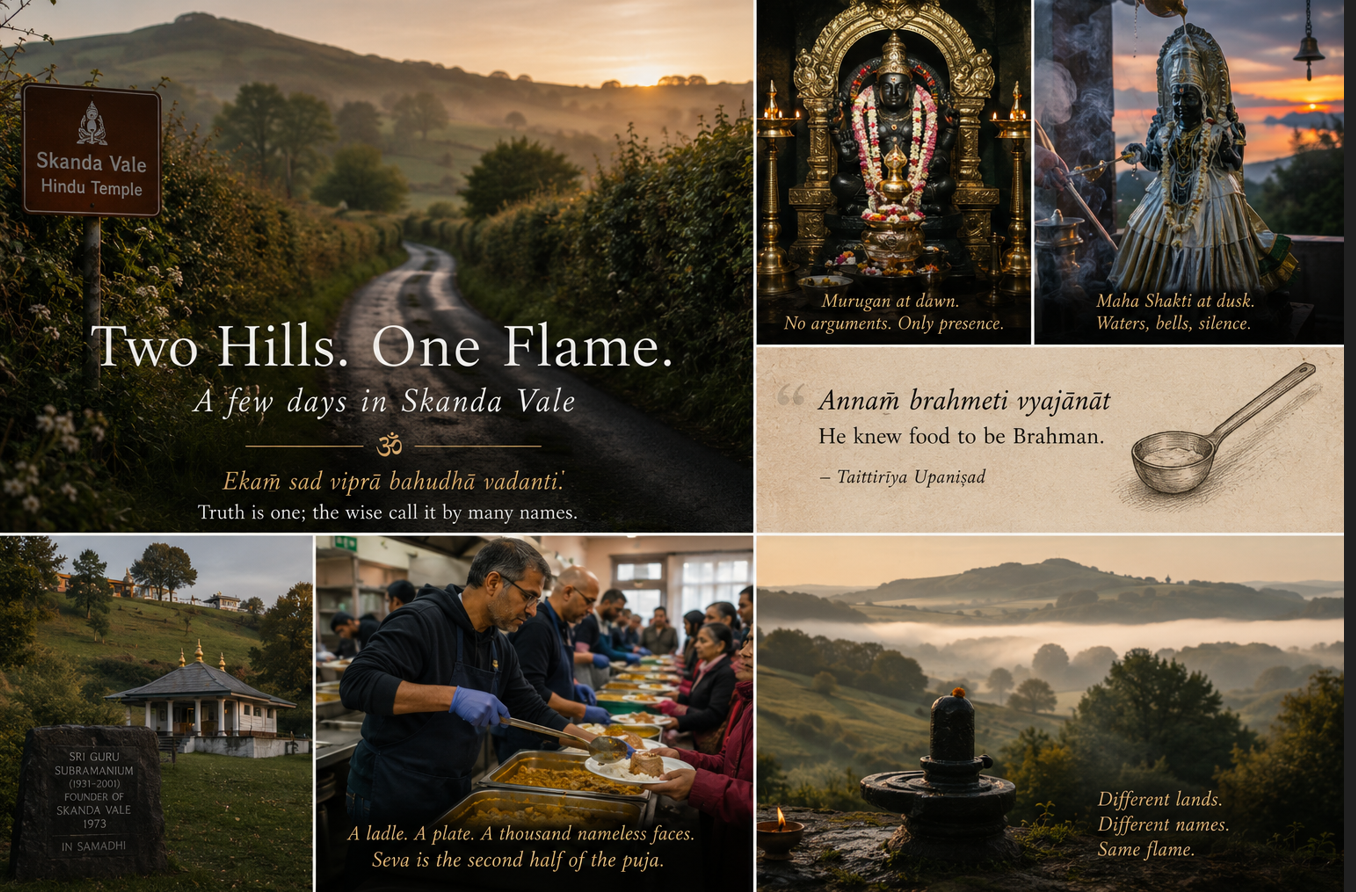
The last four miles are one lane wide. Hedgerows lean in from both sides and you slow down — not out of caution, but out of something closer to consent. Somewhere between Carmarthen and Llanpumsaint, the road stops being a road and becomes an approach.
We had been here once before. A day visit — arrive with a thermos, leave before the light goes. This time we stayed. Two days, three nights: Juri, Abhiroop and I in a small room in the valley. I remember thinking we had brought far too much luggage for a place that would ask us to put things down.
There is a difference between visiting a temple and living inside its rhythm. A visit is something you do. A residence is something done to you.
Five in the morning
The day begins at an hour that has no arguments in it. The Murugan puja starts at five, and five does not negotiate — you rise or you don’t, and either way the puja happens. That indifference is its own teaching. The valley is not waiting for me to be ready.
Then, at dusk, up the hill: Maha Shakti.
Water on stone. Milk on stone. The bell, the conch, smoke lifting into cold Welsh air, and the murti standing absolutely still while everything else moved around Her. At some point during the abhishekam I stopped watching the ritual and the ritual began watching me. No vision. No light. Nothing I can hand you as evidence — only a plain certainty that arrived without argument and left no receipt: I was not in a building in Wales. Or rather, I was, and it made no difference at all.
Murugan in the dark. Mother at nightfall. By the second day I had stopped trying to tell them apart.
Abhiroop stood beside me through most of it. I explained very little. Children don’t learn devotion from explanation; they learn it from proximity — from watching what their parents go quiet in front of. Juri needed no explanation at all. She simply folded into the place, as she does.
What I recognised
Some time ago I sat at Badrika Ashram, in the Himalayan foothills. Standing in Carmarthenshire — an ocean and an entirely different mountain range away — I felt the same energy. Not a similar one. The same.
The two places share almost nothing on the surface. Different lineages, languages, landscapes, founders; Guru Sri Subramanium walked these Welsh fields from 1973 and lies in samadhi on the hillside now. Yet what pervades both is identical in texture — an absolute seriousness about the divine, held together with an absolute absence of self-importance about it. Nobody performing. Nobody selling. The work simply done, day after day, whether or not anyone is watching.
Ekaṁ sad viprā bahudhā vadanti. Truth is one; the wise call it by many names. I have quoted that line for years. Here I understood it is not a statement about tolerance. It is a statement about plumbing — about where the water actually comes from, whichever tap you happen to be standing at.
The ladle
On both days, I served food.
Weekends bring five hundred, sometimes a thousand people through this valley. Everyone is fed. Nobody pays. I stood at the counter and put food onto the plates of more than a hundred people at a stretch, and by the end of it my back ached and my mind had gone quiet in a way no cushion has ever managed.
Annaṁ brahmeti vyajānāt — he knew food to be Brahman. Not a metaphor. Rice is Brahman when it reaches the person who is hungry.
The swamis and the volunteers who have fed this valley for decades, without a line of credit to their name — they were the real darshan. The Toltec would call it impeccability: not perfection, but the refusal to do a half-hearted thing in front of God, even when the thing is a spoonful of rice for a stranger whose name you will never learn.
Coming down
We drove east on Monday. The lane widened into a road, the road into a motorway, and by Bracknell the whole thing had the texture of something that might not have happened.
I did not come home with answers. I came home with a suspicion — that the line I have quietly kept all my life between the sacred hours and the ordinary ones is not a real line, and never was. That seva is not what you do after the puja. It is the second half of the puja.
If something in this stirs you, go. Not for a day. Stay. Rise at five. Take a ladle.
See what the hills tell you. They have been saying it a long time.