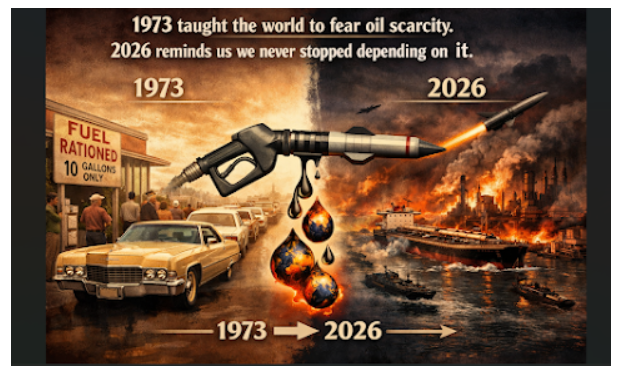
Once upon a time, Americans drove what could only be described as land yachts.
These were not just cars—they were statements. Massive in size, often as large as small trucks, these vehicles defined the automotive culture of the 1950s through the early 1970s. Inside, they were drenched in luxury—leather, wood, chrome, plush carpets, and glass. Comfort, status, and opulence mattered far more than efficiency.
Under the hood, these machines carried enormous V8 engines—5 to 7 litres in size. Yet, despite their scale, they were not particularly efficient or powerful by today’s standards. Fuel consumption was high, but few cared. Petrol was cheap, and abundance was taken for granted.
Dominated by the “Big Three”—Ford, General Motors, and Chrysler—the American automotive industry thrived on this philosophy.
Meanwhile, Japanese automakers quietly entered the US market with a very different approach. Their cars were small, simple, fuel-efficient, and affordable. At the time, they were dismissed as “toy cars” and struggled to gain acceptance.
Then came 1973.
The world was shaken by the oil crisis, triggered by geopolitical tensions during the Yom Kippur War. In response to US support for Israel, Arab members of OPEC cut off oil supplies to the United States and other Western nations.
The impact was immediate and dramatic.
Fuel prices surged nearly fourfold. Petrol, once cheap and abundant, became scarce and rationed. Long queues formed at petrol stations. People waited hours for limited fuel. The government imposed a national speed limit of 55 mph to conserve energy. Even public buildings reduced lighting to set an example.
For the first time, Americans were forced to confront a new reality—fuel was not infinite.
This shift changed everything.
Suddenly, the appeal of large, fuel-hungry land yachts faded. Consumers began to value efficiency, reliability, and affordability—the very strengths of Japanese cars.
What was once dismissed became desirable.
Over the next two decades, Japanese automakers like Toyota and Honda steadily gained market share. While American brands remained strong, their dominance was no longer absolute. The monopoly had been broken.
The oil crisis did more than disrupt fuel supply—it reshaped consumer behaviour, industrial strategy, and global competition.
1973 vs Today
There are echoes of 1973 in today’s world, with geopolitical tensions again influencing energy markets. However, key differences exist.
Today, global oil supply is far more diversified. The United States itself is now one of the largest producers. Other major contributors include Saudi Arabia, Russia, Canada, and China. Unlike the 1970s, supply is no longer concentrated in a few regions.
Additionally, the world now relies on a broader energy mix—natural gas, nuclear power, and renewables reduce dependence on crude oil alone.
While oil prices remain volatile, the likelihood of a sudden fourfold spike, as seen in 1973, is lower in today’s competitive and diversified market.
Final Reflection
1973 was not just an energy crisis—it was a wake-up call.
It taught industries and nations a fundamental lesson:
efficiency, resilience, and diversification are not optional—they are essential.
And perhaps, in a different form, that lesson still echoes today.

