Among all emotions that guide human life, gratitude stands as one of the most powerful. No matter the circumstances, gratitude can shift our perspective, helping us focus on the light rather than be consumed by the darkness. It is more than just saying “thank you.” Gratitude is a way of seeing, a lens through which life feels fuller, more peaceful, and more meaningful.
I realized this truth about a decade ago when I was living in Gurgaon, in northern India. Winters there can be unforgiving, with temperatures plummeting and thick fog covering the streets. That year was particularly harsh. Daily reports spoke of deaths caused by the cold wave, especially among the homeless.
Not far from my home in Sector 56, a community of Banjaras—nomadic Rajasthani soil craftsmen—lived in makeshift shelters. Their lives were precarious: tarpaulin sheets for roofs, open cooking fires, and no toilets or proper protection against the elements. In that biting winter, their vulnerability became painfully evident.
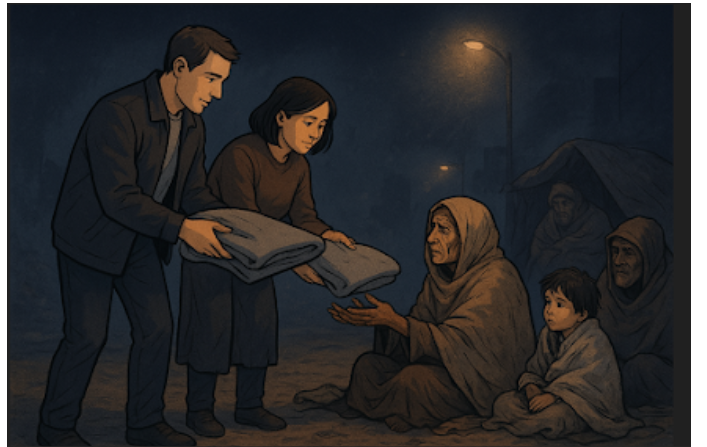
One night, my wife, a close family friend, and I decided to act. We bought around 120 blankets, loaded them into our cars, and set out close to midnight. The air was icy, about three degrees Celsius, with fog blurring the streetlights. The silence was eerie; even stray dogs had retreated into hiding.
When we reached the settlement, the sight was overwhelming. Families were huddled on pavements, some curled under cardboard sheets, others covered with jute sacks, and many wrapped only in newspapers. Old men, women, children, and even infants were all curled tightly to conserve warmth. Sitting in our heated car, I felt guilty—sheltered, comfortable, and privileged. I had witnessed poverty before, but that night, I truly saw it.
As we began distributing blankets, the reactions varied. Some were overcome with joy, even tears; some were cautious, fearing we might be police; others were drunk and barely stirred. Yet, not a single person demanded money or anything beyond that one blanket. Despite their ragged clothes, worn bodies, and years of malnourishment, their eyes carried a remarkable expression: peace and acceptance.
Many unwrapped the blankets immediately, wrapping themselves in relief. Others folded theirs carefully, perhaps to sell later or to preserve for future use. None of that mattered to us—we had done what we could, an act of service we considered our karma.
One moment, however, pierced me deeply. As word spread of our distribution, more people rushed toward us. Among them was a physically and mentally challenged girl. She stumbled multiple times as she tried desperately to reach us, fearing she might be left out. Watching her fall and rise again, determined to grasp a single blanket, was almost unbearable. It revealed not just the harshness of poverty, but also the raw desperation that survival demands. Emotionally drained, we completed our task and left.
That night, as I lay in my warm bed, gratitude washed over me. I looked at my roof, my heated room, my kitchen stocked with food, and my bathroom—a private, simple convenience I had always taken for granted. I asked myself: what good fortune, what karma, had allowed me such comforts while others had none?
The images of those families stayed with me. They had no roof, no secure place to cook, bathe, or store belongings. What I considered basic necessities—shelter, food, hygiene—were luxuries to them. Yet, their gratitude for a single blanket was more profound than what many of us feel for all the abundance in our lives.
It struck me then that gratitude is not about how much one owns. It is not dependent on wealth, possessions, or social status. Gratitude is a state of mind, a posture of the heart. If one waits to be grateful until they acquire enough, gratitude will remain elusive—because “enough” keeps shifting. There will always be something more to desire.
Instead, gratitude invites us to cherish what already exists. It allows us to pursue joy and ambition, but without losing sight of present blessings. When practiced, gratitude becomes like an invisible blanket itself—warming us, strengthening us, and instilling peace.
There are, I believe, two dimensions of gratitude. One is directed toward the divine: prayer, acknowledgment of life’s gifts, and trust in God’s provision. Many find courage and strength through daily prayer, which itself is an act of gratitude. Yet prayer alone is incomplete. True gratitude extends outward, toward other people. It flourishes in relationships where appreciation is openly expressed, where ego and ignorance do not blind us to the contributions of others. Gratitude and love walk hand in hand—each incomplete without the other.
Gratitude can manifest in small gestures, from a sincere “thank you” to acts of extraordinary compassion. The essence lies in its purity: expressing thanks without expectation. This is difficult in a world that often calculates reciprocity, but it is achievable.
The practice of gratitude transforms us. It nurtures generosity, strengthens emotional resilience, and purifies the heart. Such purity enables unconditional love, which in turn lays the foundation for a holistic, fulfilling life.
Reflecting on that winter night in Gurgaon, I realized gratitude’s profound lesson: it is not bound to material abundance but rooted in awareness, humility, and connection. To be grateful is to live fully, no matter the circumstances.
 abhijit1981's Blog