For most of my adult life, I did everything I was supposed to do.
I studied a serious subject. Built a respectable career.Worked across countries, functions, and hierarchies. Delivered outcomes, savings, improvements.
From the outside, it looked like success.
From the inside, something else was unfolding.
Over time, I began to feel a quiet dissonance—not with work itself, but with the way we define worth.
I watched intelligent, sincere people burn themselves out in the name of growth. I saw organisations speak of values while rewarding only numbers. I noticed how the language of “more” slowly replaced the language of “enough”.
And somewhere along the way, my enthusiasm thinned—not from laziness, but from honesty.
What surprised me most was this: Even when roles paid well, my energy didn’t return.
That’s when I realised something important:
The problem was not effort. The problem was alignment.
I found myself drawn, almost involuntarily, toward quieter questions: How does the mind work? Why do we chase validation? What does meaningful contribution actually look like?
These questions didn’t help my CV. But they helped me understand myself.
Today, I stand at a threshold—not rejecting my past, not romanticising the future.
I honour what my career gave me: Structure. Discipline. Systems thinking. Perspective.
But I no longer want to trade my inner truth for external approval.
I am learning to build a different relationship with work— one where insight matters more than intensity, where contribution doesn’t require self-betrayal, and where earning a living doesn’t mean losing oneself.
This is not a dramatic reinvention. It is a quiet recalibration.
And perhaps that is what midlife truly asks of us: Not to escape responsibility,but to meet it with awareness.
There is one agreement that can transform your entire life: be impeccable with your word. It sounds simple, but it’s one of the hardest habits to master.
Words are not just sounds; they are seeds. When planted in the mind, they grow into beliefs and shape reality. A careless word can shatter confidence. An encouraging word can spark a lifetime of courage.
I learned this the hard way. As a child, I loved to sing. I sang around the house with joy, filling every room with my voice. One evening, my father came home exhausted after a long day. With a pounding headache, he snapped: “Stop it! Your voice is terrible.”
He didn’t mean it — he was simply tired. But I believed him. From that moment, I stopped singing. I avoided music classes, I refused to sing at school, and even speaking in front of people became difficult. One sentence planted a seed of fear that grew for years.
That’s the power of words misused. They cast spells we carry long into adulthood.
But words can also heal. Years later, a teacher encouraged me: “You have a strong voice — you just need to use it.” Those words broke the old agreement I had made with myself. Slowly, I began speaking up again. Confidence returned, all because someone chose words of truth and kindness. Now my freinds and realtives know my singing talent 🙂
Being impeccable with your word means speaking with love and honesty — to others and to yourself. It means breaking the habit of self-criticism. Instead of “I’m not good enough,” choose “I am learning. I am capable. I am enough.”
It also means being mindful of how we speak to others. Gossip, lies, and harsh criticism poison relationships. But encouragement, gratitude, and honesty create connection and love. Every word either builds or destroys.
This agreement isn’t easy. Our world is full of negativity, and we’ve been trained to speak carelessly. But each time we choose words of love instead of fear, we plant better seeds — seeds that grow into peace, confidence, and joy.
Imagine a world where children grew up hearing, “You are strong. You are loved. You are enough.” Imagine relationships grounded in encouragement rather than criticism. Imagine the self-belief that would blossom in each of us.
That vision begins with one choice: to be impeccable with your word.
Today, I choose to use my words to heal, not to wound. To encourage, not to destroy. And when I stumble, I’ll try again.
Because this one agreement has the power to change everything.
Among all emotions that guide human life, gratitude stands as one of the most powerful. No matter the circumstances, gratitude can shift our perspective, helping us focus on the light rather than be consumed by the darkness. It is more than just saying “thank you.” Gratitude is a way of seeing, a lens through which life feels fuller, more peaceful, and more meaningful.
I realized this truth about a decade ago when I was living in Gurgaon, in northern India. Winters there can be unforgiving, with temperatures plummeting and thick fog covering the streets. That year was particularly harsh. Daily reports spoke of deaths caused by the cold wave, especially among the homeless.
Not far from my home in Sector 56, a community of Banjaras—nomadic Rajasthani soil craftsmen—lived in makeshift shelters. Their lives were precarious: tarpaulin sheets for roofs, open cooking fires, and no toilets or proper protection against the elements. In that biting winter, their vulnerability became painfully evident.
One night, my wife, a close family friend, and I decided to act. We bought around 120 blankets, loaded them into our cars, and set out close to midnight. The air was icy, about three degrees Celsius, with fog blurring the streetlights. The silence was eerie; even stray dogs had retreated into hiding.
When we reached the settlement, the sight was overwhelming. Families were huddled on pavements, some curled under cardboard sheets, others covered with jute sacks, and many wrapped only in newspapers. Old men, women, children, and even infants were all curled tightly to conserve warmth. Sitting in our heated car, I felt guilty—sheltered, comfortable, and privileged. I had witnessed poverty before, but that night, I truly saw it.
As we began distributing blankets, the reactions varied. Some were overcome with joy, even tears; some were cautious, fearing we might be police; others were drunk and barely stirred. Yet, not a single person demanded money or anything beyond that one blanket. Despite their ragged clothes, worn bodies, and years of malnourishment, their eyes carried a remarkable expression: peace and acceptance.
Many unwrapped the blankets immediately, wrapping themselves in relief. Others folded theirs carefully, perhaps to sell later or to preserve for future use. None of that mattered to us—we had done what we could, an act of service we considered our karma.
One moment, however, pierced me deeply. As word spread of our distribution, more people rushed toward us. Among them was a physically and mentally challenged girl. She stumbled multiple times as she tried desperately to reach us, fearing she might be left out. Watching her fall and rise again, determined to grasp a single blanket, was almost unbearable. It revealed not just the harshness of poverty, but also the raw desperation that survival demands. Emotionally drained, we completed our task and left.
That night, as I lay in my warm bed, gratitude washed over me. I looked at my roof, my heated room, my kitchen stocked with food, and my bathroom—a private, simple convenience I had always taken for granted. I asked myself: what good fortune, what karma, had allowed me such comforts while others had none?
The images of those families stayed with me. They had no roof, no secure place to cook, bathe, or store belongings. What I considered basic necessities—shelter, food, hygiene—were luxuries to them. Yet, their gratitude for a single blanket was more profound than what many of us feel for all the abundance in our lives.
It struck me then that gratitude is not about how much one owns. It is not dependent on wealth, possessions, or social status. Gratitude is a state of mind, a posture of the heart. If one waits to be grateful until they acquire enough, gratitude will remain elusive—because “enough” keeps shifting. There will always be something more to desire.
Instead, gratitude invites us to cherish what already exists. It allows us to pursue joy and ambition, but without losing sight of present blessings. When practiced, gratitude becomes like an invisible blanket itself—warming us, strengthening us, and instilling peace.
There are, I believe, two dimensions of gratitude. One is directed toward the divine: prayer, acknowledgment of life’s gifts, and trust in God’s provision. Many find courage and strength through daily prayer, which itself is an act of gratitude. Yet prayer alone is incomplete. True gratitude extends outward, toward other people. It flourishes in relationships where appreciation is openly expressed, where ego and ignorance do not blind us to the contributions of others. Gratitude and love walk hand in hand—each incomplete without the other.
Gratitude can manifest in small gestures, from a sincere “thank you” to acts of extraordinary compassion. The essence lies in its purity: expressing thanks without expectation. This is difficult in a world that often calculates reciprocity, but it is achievable.
The practice of gratitude transforms us. It nurtures generosity, strengthens emotional resilience, and purifies the heart. Such purity enables unconditional love, which in turn lays the foundation for a holistic, fulfilling life.
Reflecting on that winter night in Gurgaon, I realized gratitude’s profound lesson: it is not bound to material abundance but rooted in awareness, humility, and connection. To be grateful is to live fully, no matter the circumstances.
By your 40s, life can feel like it’s conspiring against your happiness.
You’re working 60-hour weeks just to keep pace. Your kids need money, your ageing parents need care. Your energy is stretched so thin it feels like you’re running on fumes — and yet, this is the very decade when you’re expected to be at your strongest.
This isn’t just a personal feeling. The data is grim: across 132 countries, life satisfaction bottoms out in the late 40s. You are more stressed, more tired, and more financially squeezed than at almost any other stage of life.
Welcome to the sandwich generation. Nearly 47% of adults in their 40s and 50s are supporting both ageing parents and growing children. You are the bridge between two generations — and the weight is crushing.
Meanwhile, your career is under maximum pressure. This is your last big window to build wealth before retirement. The stakes are high, but the cost is often your brain health: chronic stress literally shrinks the parts of the brain responsible for decision-making.
Have you heard of Ray Dalio? I hadn’t either — until someone shared his story with me. That conversation sparked my curiosity and led me to dive into his work. Here’s a crisp summary of what I learned and the key insights that stood out.
In 1982, hedge fund founder Ray Dalio hit the wall.
A massive prediction went wrong, nearly killing his company. He lost money, credibility, and confidence — all in one blow.
Most people would have quit. Dalio didn’t. Instead, he built something new: The Leverage Principle.
The idea was simple but radical:
Don’t work harder — multiply your output.
Dalio engineered his work so that 1 hour of his time produced the impact of 50 hours. That shift transformed his struggling hedge fund into Bridgewater Associates, a $150B giant.
Dalio’s 4 Leverage Strategies for Surviving Midlife Pressure
1. Mental Clarity through Meditation Dalio starts each day with 20 minutes of transcendental meditation. Why? It cuts cortisol (the stress hormone) by up to 30% and quiets mental noise. When your inner world feels chaotic, clarity becomes your most powerful form of leverage.
2. Relationship Optimization The longest-running Harvard happiness study is clear: good relationships keep us healthier and happier. Dalio conducts “relationship audits,” focusing only on people who energize him. In midlife, it’s not how many people you know — it’s who lifts you up.
3. Strategic Leverage Dalio uses three tools to multiply results:
Technology – Document once, reuse forever.
Principles – Codify lessons so mistakes don’t repeat.
People – Hire those better than you, then get out of their way.
4. Intentional Day Design Dalio starts his mornings identifying 2–3 high-leverage actions and tackles them when his energy is highest. No more wasting prime hours on low-impact work.
The Real Secret: Constant Recalibration
Dalio doesn’t “set and forget.” He runs:
Weekly reviews – What worked? What didn’t?
Monthly check-ins – Are my goals still aligned?
Quarterly resets – Adjust course before drifting too far.
Midlife can crush you — or it can forge you. The difference lies in how you manage the squeeze.
By multiplying impact instead of multiplying hours, you protect your mind, your energy, and your relationships. The pressure will always be there — but you decide whether it breaks you or builds you.
There’s a saying that if you dedicate your energy to a selfless cause, the Universe will align to support your intention and ensure it thrives. With that belief, I’ve decided to revive this long-inactive blog to share positivity and purpose. Last week, I published a post exploring the Nature of the Mind, Post editor: Preview illustrated through the example of the grass-eating lion, drawing from Sanatan/Indian philosophy.
In what felt like a universal connection—or beautiful coincidence—my respected Guru, Prof. Dr. Arun Tiwari Sir, ( Arun Tiwari – Wikipedia) introduced me to a short yet profound e-book titled The Four Agreements. Written by Don Miguel Ruiz, a Mexican author born in 1952, the book distills ancient Toltec teachings into a path for spiritual awakening and personal freedom.
Dr. Tiwari Sir encouraged me to absorb this wisdom and summarize it here through my blog.
The Four Agreements are simple yet deeply transformative principles from Toltec wisdom—an ancient Mexican tradition that emphasizes self-mastery, inner peace, and living in harmony with truth and love:
Be Impeccable with Your Word – Speak with honesty and intention. Avoid using language to harm yourself or others.
Don’t Take Anything Personally – What others say or do reflects their own reality, not yours.
Don’t Make Assumptions – Communicate clearly and ask questions to avoid misunderstanding.
Always Do Your Best – Your best varies day to day; doing it helps you live without regret or self-judgment.
Before I reflect on these four agreements individually, I feel compelled to share how Toltec wisdom views the nature of the mind —a perspective that echoes our own spiritual heritage. As we say, Truth is universal.
At the heart of Toltec thought is the idea that the mind is always dreaming—whether we’re awake or asleep. In our waking state, we interpret life through filters shaped by societal conditioning, beliefs, and expectations. This collective filter is what the Toltecs call the dream of the planet. We’re born into this dream and are gradually “domesticated” into it—trained to behave through a system of praise and punishment, much like animals.
Over time, we internalize this dream. We develop a Judge—an inner voice that evaluates everything we do—and a Victim, the part of us that feels unworthy, ashamed, or guilty. These voices are formed by agreements we never consciously made, yet they shape our lives.
Toltec wisdom explains that this mental state is like a fog or mitote—a swirl of conflicting thoughts and beliefs. In Indian philosophy, we refer to it as maya—illusion. It prevents us from seeing our true self, which the Toltecs describe as pure light and love.
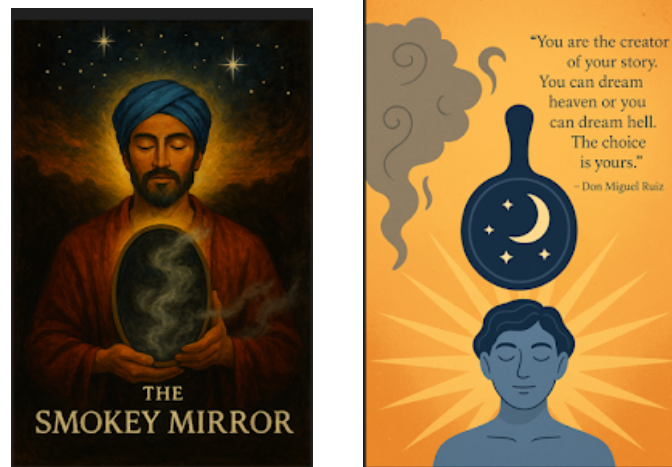
This insight was beautifully illustrated through a story: a man, thousands of years ago, dreamed he saw himself sleeping. Under a star-filled sky, he realized, I am made of light. He named the stars tonal (the material world), the space between them nagual (the spiritual essence), and the binding force Life or Intent. He called himself the Smokey Mirror, understanding that while all matter reflects divine truth, our beliefs—the smoke—obscure it.
So why do we suffer? Because we try to be what we are not. We chase images of perfection shaped by others, and when we inevitably fall short, we reject ourselves. The more we pretend to be something else, the more distant we grow from who we really are.
But there’s a way out.
Since our suffering stems from unconscious agreements, we can reclaim our freedom by breaking those rooted in fear. This frees up the personal power we’ve used to maintain them. And with that power, we can begin to dream a new dream—one grounded in self-acceptance, joy, and authenticity.
The first step is awareness: to see the dream for what it is and question the beliefs that run our lives. Who told you you’re not enough? Whose ideal are you trying to fulfill?
You are already complete. You are a mirror of divine light. The smoke may cloud your reflection, but the light has never left.
As Don Miguel Ruiz wisely says: “You are the creator of your story. You can dream heaven or you can dream hell. The choice is yours.”
Over the next four blog posts, I’ll explore the core principles and timeless wisdom of “The Four Agreements.”
I am reminded of a story I read in childhood about a lion cub raised among goats. Orphaned at birth, he was adopted by a young girl who fed him goat’s milk and raised him alongside her herd. Over time, the lion cub began behaving like a goat—eating grass, feeling fearful, and never realizing his true nature.
One day, he got lost in the jungle and instinctively ran in fear when he saw a wolf. But to his surprise, the animals fled from him. This unfamiliar experience sparked a subtle awareness within. As he wandered deeper into the forest, he noticed the same reaction from other animals. Eventually, he encountered a pride of lions feasting on a kill. Something awakened inside him—a primal desire. Acting on it, he hunted a calf and, for the first time, felt the exhilaration of being what he truly was. From that moment on, the goat-like lion transformed into the king of the jungle.
This story echoes our own journey. Like the lion, we are born fearless and whole. Yet, from early childhood, society conditions us—instilling beliefs about who we are, what we should be, and how we should behave. Over time, we learn to seek validation from others, shaping our identity through approval and comparison. This deep conditioning clouds our true nature, replacing inner confidence with doubt. The voice of our soul grows faint, and we begin to act more like the goats around us—fearful, uncertain, seeking acceptance.
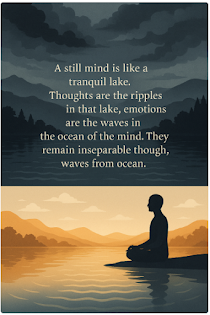
The external world we perceive is only a reflection of our inner state. When our inner world is in chaos, the world around us feels threatening. Our thoughts and emotions ripple like waves on a lake, disturbing the stillness within. As Confucius said, the human mind is more unpredictable than nature itself.
To return to our true nature—the fearless lion within—we must still the mind. Through awareness and meditation, we can observe the restless flow of thoughts and emotions, and gradually reconnect with the deep peace and clarity that lies beneath. A calm mind, like a tranquil lake, reflects reality clearly and completely. If you able to observe the anatomy of the mind, and observe the flow of thoughts you will realize that how our mind is like constantly under the wave/ripples of emotions. You will realize that mediation is the only remedy to bring a still mind
Meditation is not an escape; it is the only way to rediscover the self we’ve forgotten.
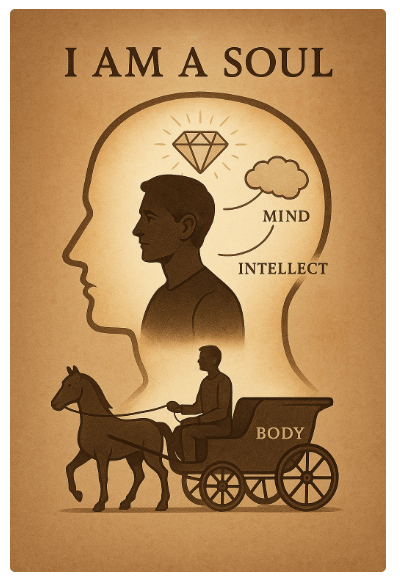
I am a living entity—distinct from the body I inhabit. Just as a person uses a telephone to speak or listen but is not the telephone itself, I, too, use the body as an instrument. I am not the body, but the one who sees through the eyes, hears with the ears, speaks through the mouth, and feels, thinks, and acts. These faculties are tools—I am their master.
I am the soul (Atma), eternal and immortal. The body is perishable, a temporary vessel given to me for performing actions and experiencing their consequences. I am both the doer and the one who undergoes the outcomes of those deeds.
Like a driver controls a carriage, I—the soul—am in charge of the body, which serves as my vehicle. The soul is like a diamond; the body, its casket. When the soul departs, the body is declared dead. People say, “The light has gone,” meaning the living essence has left, and the drama has come to an end.
The mind is the soul’s thinking faculty. It imagines, creates thoughts, and forms ideas. Thoughts give rise to emotions, desires, and sensations. In a moment, the mind can revisit the past, project itself into the future, or reach distant places. It is the mind that navigates moods and internal experiences.
The intellect is the faculty that evaluates thoughts. It is the center of understanding, judgment, and decision-making—arguably the most vital of all. A refined intellect allows for clarity, deep realization, and sound reasoning. It is through the intellect that we remember, discern, judge, and exercise willpower.